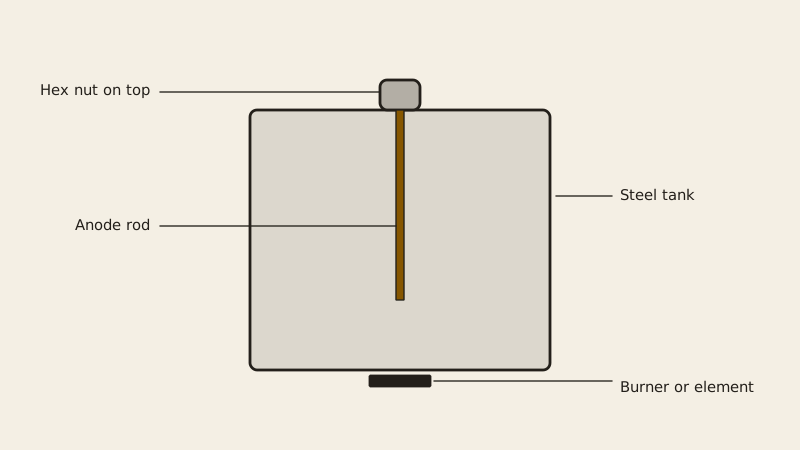
Hanging from the lid of most storage heaters is a skinny metal rod nobody ever sees. It is made of aluminum, magnesium or zinc, and its whole job is to rot. Corrosion goes for the rod before it goes for the steel shell, so a fresh rod buys the tank more years. A used-up one buys nothing.
What follows is practical: how to judge the rod, the steps for swapping it, where trouble starts, and what Rancho Cucamonga and Upland water does to the equation. Wider heater questions live on the water heater overview.
What is that rod inside the tank for?
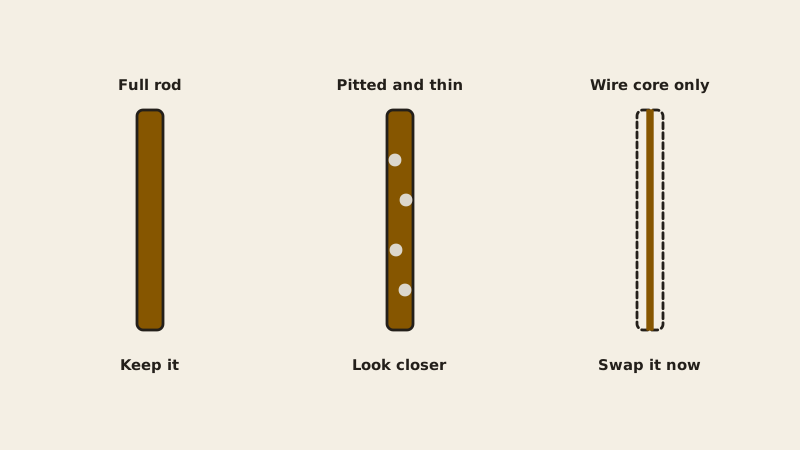
It sacrifices itself so the tank does not have to. Water in a steel tank wants to corrode something, and the rod is deliberately the easier meal. A source we read says that once just the wire core is left, the tank is likely to fail soon after. A tankless unit skips the tank, and the rod with it; see tank versus tankless to choose between types.
Nothing about the rod shows from outside. You find out by pulling it, or by the day the tank starts to leak.
Is the water around here hard on rods?
We have hardness numbers, not rod lifespans, so no local interval can be promised. CVWD's 2025 report puts total hardness between 109 and 142 ppm, averaging 125.5, near 7.3 grains per gallon. Upland's own system reported about 163 ppm in 2024, close to 9.6 grains.
Scale and corrosion tend to pile up together on the tank floor. Because the numbers differ across the area, a yearly look is the sensible start, adjusted after you see how fast your rod wears.
When is a rod finished?
When most of it is gone or only the wire core is visible. The article says manufacturers want a look yearly, though hardly anyone does it. Pitted, thin, crusted: all signs it is nearly done. A rod that looks fine can simply go back in the tank, which makes the check cheap insurance.
Water chemistry sets the pace. The author's whole-house rod was consumed in around four years, and a point-of-use rod in one. That is one man's water, though, not ours.
How does the swap go, start to finish?
Five moves. Turn off gas or power and close the cold supply. Open a hot faucet so pressure bleeds off, and let a few gallons out. Break the hex nut on top of the tank loose. Slide the old rod out. Wrap the new rod's threads with Teflon tape, thread it in, and bring everything back on.
The nut is 1-1/16 inch. The author reaches for a half-inch impact wrench, calling it far better than a socket wrench, and cautions that a socket wrench with a pipe extension can twist the entire heater and put stress on the water and gas piping. Many owners hand this one off.
What will an anode rod swap run?
One price turned up in our reading: the article's author spent $159.95 on a powered anode rod. That is a single purchase, not a market range, and a plumber's time is extra. No sourced labor figure for this region turned up.
Rod type, tank size and a stubborn nut all shift the bill. The full service list is on the home page. On a hired job the real figure comes after the heater has been inspected and a quote is on paper.
Rod or whole heater: which one needs replacing?
A sound tank on a youngish unit: the rod. If the tank weeps, the unit is near the end of a normal life, or repair bills keep stacking up, the heater. A new rod cannot fix a shell that has already corroded. Water on the floor by the base is covered in fixing a heater leak.
Close to retirement age? Check water heater replacement cost before buying parts. Other wear items have their own pages: the heating element and the relief valve.
Who should do it: owner or plumber?
Pass it on if the nut will not break loose, headroom is tight, the heater burns gas and the connections worry you, or any wetness shows up. While the tank is open a contractor can also check the relief valve, thermostat setting and sediment.
In California a contractor is needed for permitted work, plus any job whose price hits $1,000. A rod swap sits under that. Replacing the heater does not: it needs a city permit, which Rancho Cucamonga Building and Safety takes online. Use request a quote to ask for a visit.
What can go wrong, and what about gas?
A frozen nut tops the list. When it refuses to turn, stop pushing: a long cheater bar can rock the tank and loosen fittings, and a weeping connection costs more than the rod. Headroom is the other snag, because a rigid rod normally needs clear space overhead to slide out of the tank.
On a gas heater, a whiff of gas means walk out first. Ring SoCalGas's emergency line (1-800-427-2200), or 911 if it cannot be reached. Leave pilots dark until the line is cleared.
Common questions
Does it take long?
For someone with the right socket and an impact wrench, the work itself is brief, with extra minutes to drain some water first. A seized nut or cramped closet adds time. A plumber might pair the swap with a tank flush, so ask what the visit will include and how long to expect.
What can a plumber tell me that a rod check alone cannot?
How much sediment sits in the tank, whether the relief valve and thermostat behave, and whether the heater deserves a new rod at all. Ask which rod type is going in and why, and how a stuck nut gets freed without twisting the tank. Verify any contractor's license through CSLB.
Does swapping the rod put the warranty at risk?
Read the manual and the maker's terms first. Some warranties expect maintenance, but the article we read says nothing about warranty terms, so we will not guess. Hold on to the receipt and jot the date, whoever did the work.
Should someone be at the house for a service call?
Yes, at least to unlock the garage or closet, and again once the old rod is out and the plumber can report on its condition. Hot water will be unavailable until the tank has refilled and the heater is switched back on.
Updated