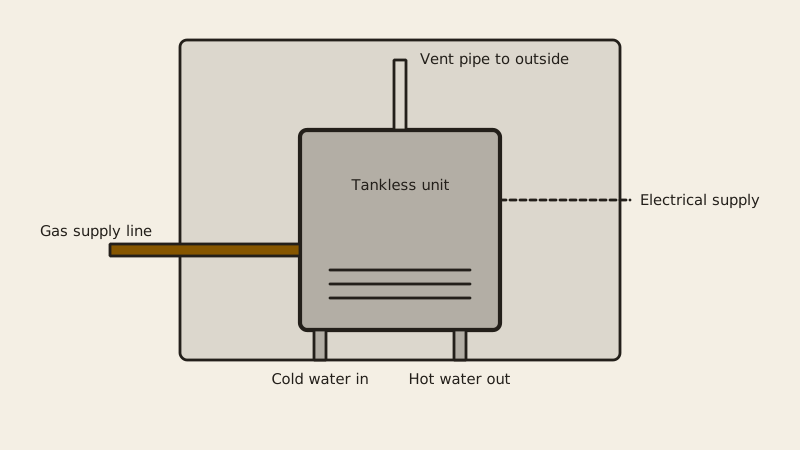
This Old House reports $1,200 to $3,500 for a whole-home tankless unit with installation, averaging about $2,800. Equipment and labor are both in that. The spread comes from two places: how much gas or electrical upgrading the house demands, and how awkward the old heater is to pull out. General repair and swap information sits on the water heaters page. Your own address gets priced through the quote page.
What will a tankless install run in dollars?
By fuel, This Old House shows electric at $650 to $2,500, propane at $1,400 to $3,500 and natural gas at $1,650 to $3,500, all installed. A second guide quotes $1,500 to $4,500 for tankless in general, climbing past $5,500 if the gas line, vent and wiring all need work. Expect four to eight hours of labor.
| Fuel | Installed total | Unit | Installation |
|---|---|---|---|
| Electric | $650 to $2,500 | $500 to $1,500 | $150 to $1,000 |
| Propane | $1,400 to $3,500 | $500 to $2,000 | $900 to $1,500 |
| Natural gas | $1,650 to $3,500 | $750 to $2,000 | $900 to $1,500 |
The first guide prices plumber time from $75 up to $150 hourly. Everything here is national data, and the two sources disagree in spots. Use it to frame a conversation, not as a price list, because your actual price is whatever the local plumber's written quote says.
Many Rancho Cucamonga homes run natural gas, since SoCalGas serves the city. That points to the gas row. An all-electric home, or a condo with no gas line, points to the electric row, where the real cost question is whether the panel can carry another large circuit.
Which extras push a tankless install past the base price?
Four add-ons recur: gas line size, venting, a dedicated circuit and the electrical panel. This Old House lists $350 to $750 for the gas line, $400 to $800 for venting a gas unit, $200 to $600 for a circuit and $1,000 to $2,000 for a panel, while admitting its sections disagree a little.
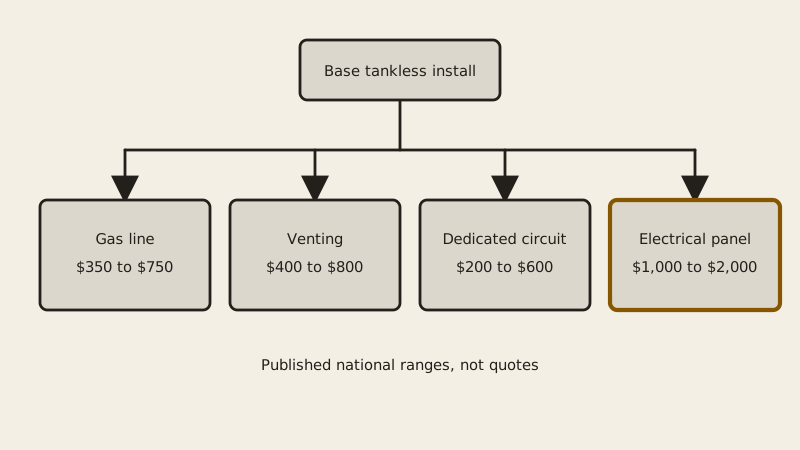
Here is why each shows up:
- Gas line. Tankless burners fire hard and need a big gas supply in one go. An older tank's half-inch feed pipe may fall short.
- Venting. Tankless units use their own vent material, and the vent run to the roof or an outside wall may be lengthy.
- Electrical. An electric whole-home unit can demand a very large dedicated circuit, and a crowded panel may need an upgrade first.
- Removal. Hauling out the old tank is listed at $100 to $500.
- Permit and inspection. Listed at $50 to $200, and $74 to $150.
Gas piping is not homeowner territory. Gas odor in the house: get outside first. Once you are outside, SoCalGas takes the call on 1-800-427-2200; use 911 if anyone is at risk. Larger conversions are priced separately; see gas line pricing.
How does that compare with replacing a tank?
One 2026 cost guide prices an ordinary 40 to 50 gallon tank heater at $900-$2,500 installed, and calls $1,400 the commonest figure. The unit, labor, permit and haul-away are all inside. For a 50-gallon West Coast job it shows $1,700 to $2,700. Tankless starts higher, so its case rests on running cost and floor space.
How the two guides split a tank replacement:
| Item | Range |
|---|---|
| Tank unit alone | $550-$900 |
| Labor (3 to 5 hours) | $300-$900 |
| Permit | $50-$200 |
| Expansion tank | $75-$150 |
| Drip pan and drain | $50-$150 |
| Seismic straps, where required | $30-$80 |
That guide does not separate 40-gallon and 50-gallon prices, only saying the smaller tank is a little cheaper. Tank versus tankless weighs running costs, and the replacement cost page deals with tanks only. A quote far under the low end may have left out the permit or the hauling.
How does local water treat a tankless heater?
Mineral scale builds on the heat exchanger. Cucamonga Valley Water District measured total hardness of 109 to 142 ppm in 2025, averaging about 125 ppm, which works out near 7 grains per gallon. The City of Upland's 2024 report lists 163 ppm, close to 10 grains, for its own system. Both are worth planning around.
Scale narrows the passages inside a tankless unit, which can choke flow and trip error codes, and it ages every kind of heater faster. Makers generally call for a periodic descaling flush; your manual names the interval. A softener or scale inhibitor upstream is one answer, and softener pricing shows what it adds.
Unsure of your supplier? Most of Rancho Cucamonga is served by Cucamonga Valley Water District, and Upland mostly by the city, with small areas on other suppliers. Your bill names it, and each hardness figure above belongs only to its own supplier.
What about permits and local rules?
Swapping a water heater is permitted work. Rancho Cucamonga's Building and Safety office handles applications online rather than at the counter, and Upland's Building and Safety Division uses an online portal as well. The plumber normally applies and an inspection follows; ask who files yours.
Skipping it has a cost later: the 2026 cost guide warns an unpermitted job could give an insurer grounds to refuse a water-damage claim. Seismic straps appear in the add-on table where required. One more point on emissions. The regional air board turned down changes to its Rules 1111 and 1121 in June 2025. That leaves ordinary gas and electric heaters fully available, with no zero-NOx rule on the way.
A tankless install clears the $1,000 mark and needs a permit, so the CSLB expects a contractor license behind the person doing it. You can verify one on cslb.ca.gov.
Which other water heater costs do homeowners ask about?
Parts-level jobs are much cheaper than a whole new heater. One plumbing company's guide puts a professional anode rod swap at about $180 to $420 all in, $150 to $350 of it labor and $15 to $40 for the rod. It says rods last about three to five years in typical water, and less where water is hard.
Other items people search for:
- Anode rod. It is built to corrode so the tank steel does not, and the guide suggests an inspection every two to three years. See anode rod replacement.
- Heating element. Electric tank heaters fail at the element. See replacement elements.
- Relief valve. This safety valve vents excess heat or pressure. See relief valve replacement.
- Gas control valve and drain valve. No reliable published range turned up for either, so only a written quote gives a figure you can rely on.
- Tankless repair. Error codes and scale are in tankless heater repair.
A pilot that keeps dying, or a gas control valve acting up, counts as a gas appliance fault. Any work on the gas piping itself needs a contractor license under California law.
Common questions
Does tankless pay back its higher install price?
Sometimes. The answer hinges on hot water use in your household and on your plans for staying in the house. Heating on demand and freeing floor space are real benefits, but savings accumulate slowly. A bigger gas line or a panel upgrade pushes payback further out, so set an itemized quote beside a tank swap.
Will a heater repair visit cost me anything up front?
Companies differ. Some bill a call-out fee, credited to the work or not, so ask first. What you will have is a written quote before the work begins. For a failing heater, mention its age, fuel, symptoms and the details printed on the tank label.
How long does a tankless changeover take?
This Old House gives four to eight hours of labor. A simple swap on an existing gas line can fit in a day. New venting, a bigger gas supply or electrical work may take longer than a day. Hot water is off while the work runs.
Which questions come before a tankless booking?
Which model, and does its flow rate suit your fixtures? Are the gas line and vent sized for it? What is inside the price? Who applies for the permit? Is there a descaling plan and manufacturer paperwork? Have the total, split into parts, labor, permit and haul-away, written down before any work.
The rest of our guides start from Cucamonga Peak Plumbing plumber.
Sources used
- This Old House, tankless water heater installation cost (checked November 2026)
- Water heater replacement cost guide (tank units, permit and add-ons; checked November 2026)
- Anode rod replacement cost guide, plumbing company (checked November 2026)
- Cucamonga Valley Water District 2025 Water Quality Report
- City of Upland 2024 Consumer Confidence Report
- City of Rancho Cucamonga, Building and Safety
- SoCalGas, natural gas leak safety
Updated