Short version: PEX usually costs less and calls for fewer openings in the wall, while copper brings the longer record and copes with sun. Both are sound choices. Planning a whole-house repipe? The sections below turn the comparison into something you can take to a quote. Choosing the material stays with you; lining up the plumber is on us.
Which is better for a house here, copper or PEX?
No single winner. PEX costs less as a raw material, curves around framing with few fittings, and survives a freeze, which suits a repipe that must leave most of the wall alone. Copper is rated for a longer life, tolerates sun and heat, and is already inside many older houses. Only someone who has seen your walls can say which suits them.
One published side-by-side of half-inch residential tubing gives these figures:
| What you compare | PEX | Copper |
|---|---|---|
| Raw tubing, a foot | 50 cents to $1 | $2 to $4 |
| Life expectancy | 40-50 yr | 50-70 yr |
| Sunlight | Poor, must be covered | Excellent |
| Hard freeze | Stretches up to roughly 15 percent | Prone to splitting |
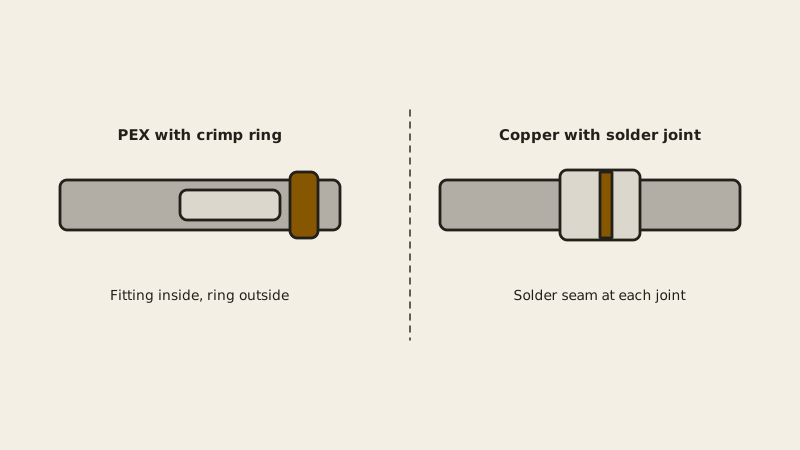
| Connections | Crimp rings or clamps | Soldered fittings |
Treat the dollar figures as tubing only, drawn from a general national source, and never as a bid for a Rancho Cucamonga house.
How much does each cost on a real project?
Tubing is the cheap line item on a repipe. Hours of labor, opening and closing walls, permits and the water heater connections make up most of the invoice, and PEX tends to come in lower because there are fewer joints to make and less cutting. Copper's higher raw price will not double the job, though over a whole house it can still add a noticeable sum.
The factors that actually move the cost of the project:
- How many fixtures and how many floors the lines must reach.
- Whether the walls are plaster, drywall or stucco, and how much patching follows.
- Slab or crawlspace routes versus attic routes.
- Permit and inspection fees set by the city.
- Whether old galvanized or other failing lines are being pulled out entirely, as in galvanized pipe replacement.
Pricing logic for the whole job sits in repipe costs in Rancho Cucamonga, and a house full of aging pipe is covered in plumbing replacement for an old house. Real money gets settled in a quote on paper from a local plumber; request one with copper and PEX priced next to each other.
Does PEX or copper flow better, and what about 1/2 inch lines?
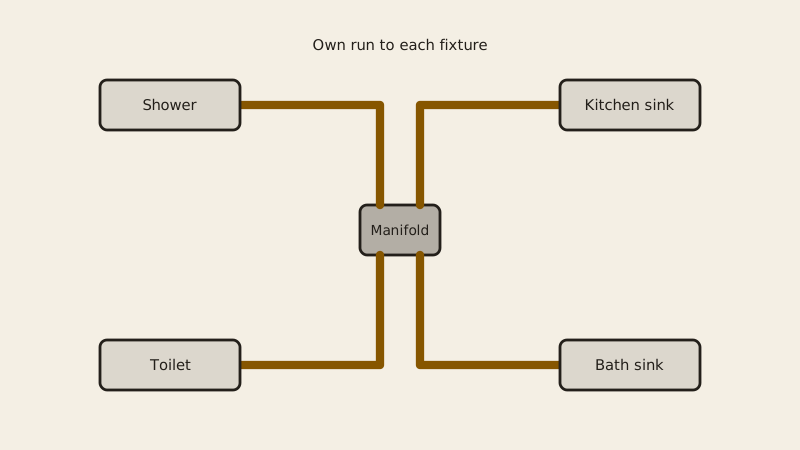
Pick the same nominal size and copper ends up with a slightly wider bore, so on paper more water gets through. At the tap of a typical single-family house you will rarely notice. PEX fittings go inside the tube and pinch it at every joint, so plumbers sometimes go a size larger or feed each fixture from a manifold.
Two practical points:
- Compare 1/2 inch to 1/2 inch only on paper. A well-laid PEX system with a manifold can serve each fixture with its own run, which helps with pressure when two showers go at once.
- Flow problems in older houses are more often corrosion or scale than the pipe type. If pressure has dropped, low water pressure is the page to read before assuming a repipe is the answer.
The water itself matters, too. Cucamonga Valley Water District's latest report (2025) puts total hardness between 109 and 142 ppm, averaging near 125.5. Upland's 2024 report gives 163.42 ppm for the city system. Scale builds inside any hot water line in water like that, so the flow benefit of a smooth interior is a long-term plus rather than a promise.
How long do the pipes last, and how do they fare in cold weather?
Copper is usually credited with 50 to 70 years of service, PEX with 40 to 50, and PEX has had fewer decades to prove it. A freeze favors PEX, which gives where copper cracks. Sun favors copper, since PEX must stay out of direct sunlight, a real issue for exposed lines outdoors or in a garage.
Cold is a smaller worry across the valley than in snow country, but foothill streets north of the city's lower neighborhoods can see frosty nights, and attic or exterior-wall runs are where it counts. Copper in aggressive water may also pinhole with age. Already seeing one? The pinhole guide, fixing a pinhole in copper, separates the temporary patch from the permanent fix.
What should the pipes in an older Rancho Cucamonga house be replaced with?
Pipe in this part of the Inland Empire spans several eras, from older galvanized and copper to newer PEX. Census figures show a large share of Alta Loma homes were built in the 1980s, Upland's median home dates to 1975, and Etiwanda's median is 2002. Age tells you what is likely in the wall, not what is failing.
A failing line is not automatically a full repipe. After pressure tests, a look at corrosion and a count of past leaks, a plumber may propose one run or all of them. For a job covering the entire house, plan on a city-issued permit, and Rancho Cucamonga's Building and Safety division accepts those applications online. The sequence of a repipe is in how a repipe goes, step by step.
Common questions
Which material finishes faster?
PEX usually does, since soldering every joint in copper adds labor. A short run may be done within a day, and a whole house stretches longer depending on wall access and patching. Whichever you choose, the quote should name a realistic window and say whether drywall repair is inside it or billed apart.
What questions settle the choice before I sign?
Request both materials priced on one scope. Ask who files for the permit, how the walls are patched afterward, and what the plumber does about a joint that weeps later. Whoever signs the quote needs a California contractor license when the job tops $1,000 for labor and parts together; the CSLB website (cslb.ca.gov) has a license search. Keep it all in a written quote.
Will I be tied to the house during a repipe?
During a whole-house repipe, someone should be around, because the water goes off in stretches and rooms need clearing. Expect noise, dust and hours without water on the busy days. A single-run repair asks less: letting the plumber in at the start and a final look-over.
Is it fine to have both materials in one house?
Generally yes. Staged repipes often join new PEX to existing copper using the proper transition fittings. Two cautions apply: use the right fitting at each junction, and keep PEX out of direct sun and off hot surfaces like a water heater flue. Ask that the transition points be marked in the quote.
Is either one safer for drinking water?
Both are widely used for household drinking water. Copper levels can rise when water is acidic, according to the comparison cited above. Your supplier's water quality report, available from Cucamonga Valley Water District at (909) 987-2591 for its customers, describes what comes through the system before it reaches your pipes.
Every service and price guide is on Cucamonga Peak Plumbing plumber.
Updated