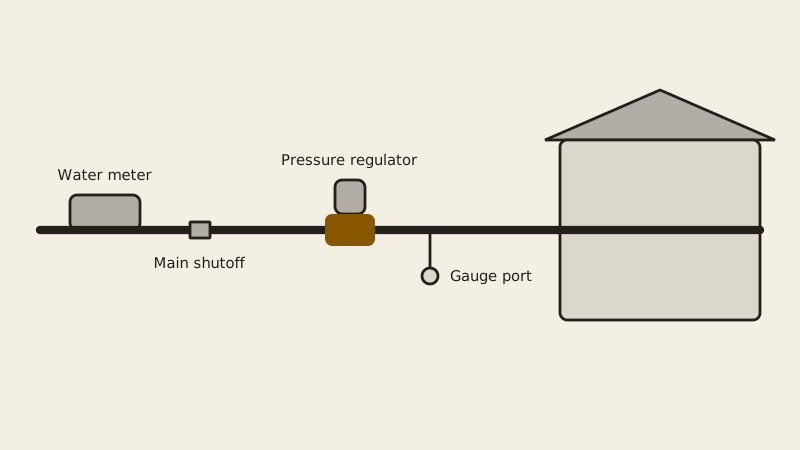
Swapping a pressure regulator in a Rancho Cucamonga house usually lands in the hundreds, rarely the thousands. The valve itself is inexpensive. Labor stays short, an hour or so, sometimes two, when the unit sits somewhere accessible. Pipe size, access and surprises behind the valve cause most of the variation. It is one page in the low water pressure and valves group, and your own house gets a written figure through the quote page, tied to the address.
What would a local plumber ask to fit a regulator?
One Southern California contractor's published guide gives $300 to $650 for a standard residential installation, with a bare-bones swap as low as $50 and complicated commercial jobs reaching $1,200. By pipe size, it lists about $200 to $400 installed for a three-quarter-inch home regulator and $300 to $600 for a one-inch unit.
Those figures separate into parts and labor like this, according to the same guide:
| Item | Typical range |
|---|---|
| Three-quarter-inch residential regulator, installed | $200 to $400 |
| One-inch regulator (larger homes, duplexes), installed | $300 to $600 |
| Part alone, three-quarter-inch | $75 to $200 |
| Labor alone | about $75 to $400 |
| Service call fee | $100 to $250 |
| Commercial-grade, multi-unit | $600 to $1,200 |
The same page puts that plumber's hourly rates at $75 to $200 and an easy replacement at one to two hours. It is a Southern California source but a contractor's own page, which makes it a benchmark and not a rate card.
Typical plumber prices in Rancho Cucamonga
In Rancho Cucamonga and Upland, a visit should fall in a similar band, about $200 to $650 for most single-family homes. No published local rate card turned up, so that Southern California guide is the best written benchmark. Your total hinges on the plumber's call-out rules and on how simple the swap turns out to be.
When quotes arrive, compare these points:
- What is included. A flat price should name the regulator, fittings or unions, labor and a gauge test afterward.
- The model. Parts alone, per the same guide: spring-loaded manual $50 to $150, adjustable $100 to $250, pilot-controlled $150 to $400, smart or digital $250 to $600.
- The call-out fee. Some plumbers fold it into the first hour; others bill it separately. The source describes it as covering the first hour and travel.
- The clock. Evening and weekend rates run higher than daytime.
All of this is a published guide. A local plumber's written quote, prepared after seeing where your regulator sits, sets the real price.
Which factors move the final bill?
Four things set the bill: size, access, pipe condition and extras. The cheap case is a regulator in a clear, reachable spot near the main shutoff. The costly one is buried in a wall, sunk in a front-yard box or threaded onto corroded pipe. A dead shutoff valve, or a missing union, can turn a one-hour visit into half a day.
What pushes a quote up:
- Pipe size. One-inch lines cost more than three-quarter-inch.
- Access. Crawlspace, garage ceiling or an underground box.
- Corroded or galvanized pipe. Threads that will not hold may force a section of new pipe. Galvanized pipe replacement shows when that becomes the larger job.
- No shutoff. A house with a seized main shutoff needs that fixed first.
- Extra devices. An irrigation backflow device can add $200 to $1,000, plus $100 to $200 a year to test, according to the guide.
- Permits. The same guide mentions permit fees on some jobs. Whether a swap needs a permit in Rancho Cucamonga is a question for the city's Building and Safety staff, who handle permits online, not at a counter. Upland's Building and Safety Division answers the same question for that city.
What trims it: an easy-to-reach regulator, a main valve that works, a same-size same-type swap, and a visit that doubles up with another small job.
Is the regulator really the culprit?
The signs split two ways. Excess pressure announces itself with knocking pipes, a weeping relief valve near the water heater, fixtures that die early and spray that stings. A failing regulator can also starve the house, then surge. A cheap gauge on an outside hose faucet reads the true figure in seconds.
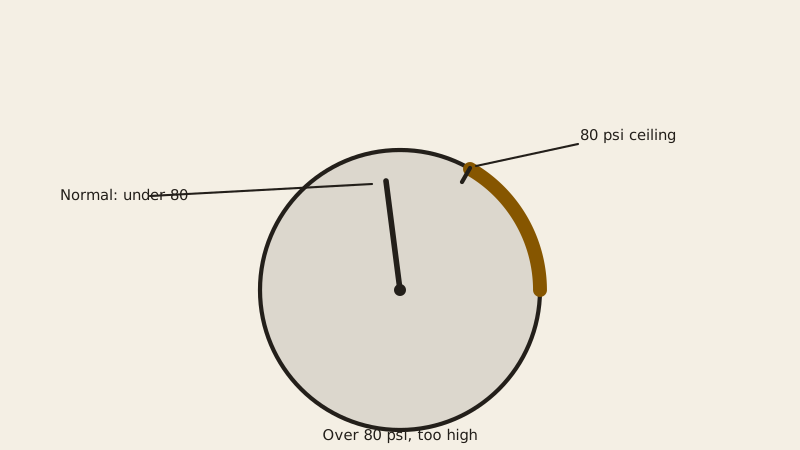
The plumbing code the state follows, section 608.2, treats 80 psi at the fixtures as the ceiling. If your gauge reads higher, the regulator is drifting, or the house has none and the plumber may suggest adding one.
Related reading: adjusting a regulator valve, pressure that drops suddenly and water hammer noise. A leaking regulator can also push up the water bill.
Who looks after the regulator: the water district, or the homeowner?
The homeowner. The Cucamonga Valley Water District FAQ says a customer who has a regulator on the property is responsible for maintaining it, so a failing one is not something the district will come out and fix. Past the meter, the pipes and the regulator are the owner's property, and need periodic attention.
Homes outside the district, such as parts of Upland run by the city or another water company, are probably similar, but ask your supplier; the bill names it. Older houses are the likeliest to still hold an original regulator, and a unit that age is a candidate for replacement ahead of a failure.
A licensing line applies as well. Under the CSLB, a $1,000 total for parts and labor, or any work that triggers a permit, is the point where a California contractor license applies. A regulator swap typically stays beneath that figure; a re-pipe does not. The CSLB site carries the current contract and deposit rules.
Common questions
How long is the visit?
The same guide says an accessible swap is one to two hours. A corroded fitting, seized shutoff or buried regulator adds more. Taps go dry for some of that time, so ask when, and fill a pot or finish showering first.
What details should the written quote include?
Look for a total with fittings, call-out and the final gauge test itemized, the model and its set pressure, whether you keep the old valve, and a line about permits. Have all of it in hand before anything is cut or removed.
Should somebody be home?
Somebody over eighteen should give access to the regulator, the main shutoff and the water heater area, and check the result. If the valve is outside or in the garage, that may be all it takes. The house will have no water for a stretch.
Could I fit one myself?
Only for someone at ease cutting and joining pipe, closing the supply and setting pressure against a gauge. A hidden leak or a badly set valve does real damage. Old pipe, or doubt about the shutoff, makes a plumber the safer pick.
Budget sorted? plumber in Rancho Cucamonga explains the rest of the job.
Updated