Repiping means pulling out the old supply lines, hot and cold, and running new ones from the main shutoff to every faucet, tub and appliance. PEX is the usual choice now. Expect thousands of dollars, set mostly by pipe material, fixture count and wall access. Want someone local to inspect and name a figure in writing? Fill in the request form.
What tells you it is time to repipe?
Look for a pattern, not a single event: pinholes that keep showing up in copper, rusty or brown water for the first few seconds after you open a tap, weak flow at every fixture, and green crust around fittings. A lone leak is a repair job. A trio within a few years, scattered around the house, hints that the pipe wall is thin everywhere.
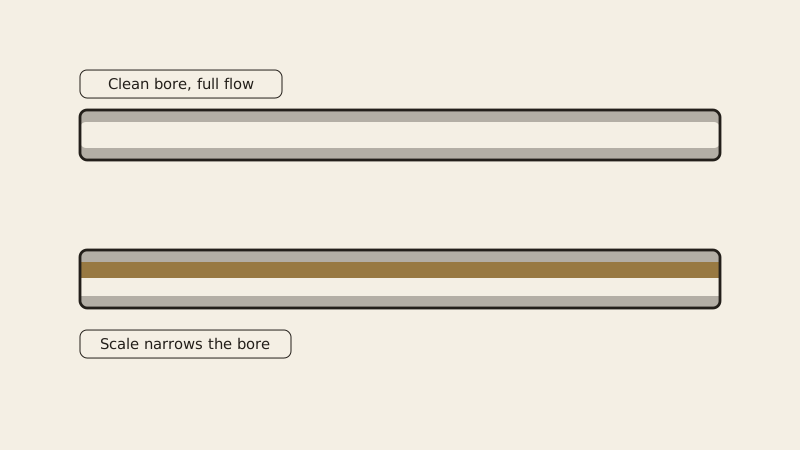
Age counts as well. In Upland's ZIP 91786 the Census lists 1,331 homes from before 1940 and 706 from the 1940s, and houses from that era could still contain galvanized steel that narrows from the inside. The galvanized pipe replacement guide goes deeper. Newer Rancho Cucamonga homes are less likely to reach this point, though your plumber has to see the pipe to say.
Must the entire house be done?
No. A sick stretch can be cut out and swapped, and a short run behind an opened wall is far cheaper than a total job. The case for going whole-house is a material that is itself failing (galvanized, an old plastic), or patches that never stay patched.
Ask whoever inspects to show you the damaged section and explain why it points to a house-wide problem. A pressure test and a glance at the water heater connections reveal a lot at little cost. When the trouble is one bathroom or a leak under concrete, a reroute set against a full job is weighed in slab leak versus repipe.
Which pipe goes in today, PEX or copper?
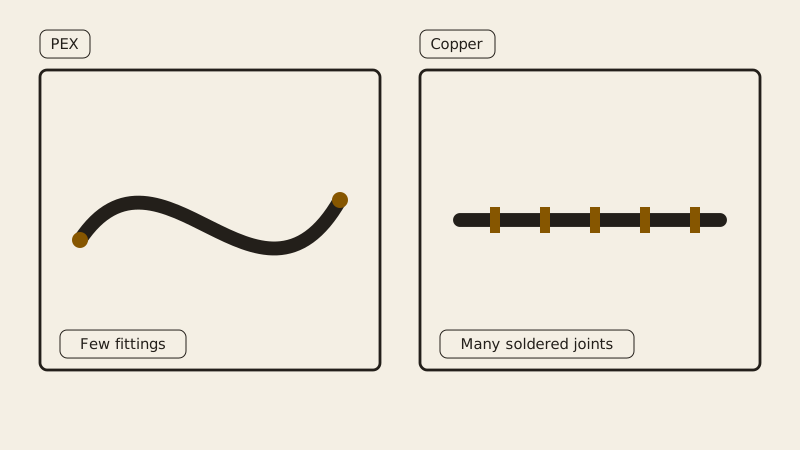
Flexible PEX tubing dominates whole-house work: it threads through framing with very few joints, runs cheaper, and goes in fast. Copper stays on the menu for owners who like its long track record, though soldering every single joint takes far more labor, and that labor is billed to you.
A contractor guide read for this page expects PEX to last four to five decades and copper five to seven, and says copper usually lacks a manufacturer warranty where PEX often has one. Water chemistry plays in too: Cucamonga Valley Water District measured 2025 hardness between 109 and 142 ppm, moderately hard. Trade-offs between the two are compared in PEX versus copper.
What do whole-house repipes cost?
One contractor guide gives PEX a span of $3,500 up to $11,000 and copper $5,000 up to $20,000, with PEX in homes under roughly 2,200 square feet averaging about $5,800. HomeLight, quoting HomeAdvisor, runs from $3,600 at 800 square feet to $13,500 at 3,000. Treat these as national yardsticks, not Rancho Cucamonga prices.
Labor takes about three quarters of the money in that guide. More fixtures, plumbing hidden inside finished walls and slab foundations all raise the number. Wall patching is frequently missing from the first estimate and can add a surprising sum, so raise it early. The line items are itemized on the repiping cost page.
How can you spend less on a repipe?
Choose PEX, route it through open attic or crawlspace wherever possible, and open walls only at fittings. Another lever is scope: if the rest tests sound, replacing one failing branch rather than the whole system trims the bill, and the plumber can leave sound pipe in place.
Treat a bid far under the others with suspicion. The gap usually hides omissions such as no permit, no drywall repair, no new shutoffs or no pressure test. Ask every bidder to itemize, then compare line against line. An itemized, slightly higher quote often works out cheaper than redoing a bargain job.
How many days does the work last?
According to one published guide, the typical whole-house job lasts anywhere from three to seven days. PEX lands at the short end; copper stretches because each joint is soldered. Plaster walls, an upper floor or a slab add more. Plan for dry taps at times, and shower and cook accordingly.
Request a schedule by day: rooms opened first, hours without water, and who repairs drywall. That last step is frequently a separate trade arriving afterwards. Expect dust, small wall openings, and a bathroom that is out of action for some hours.
What does California say about doing it yourself?
The state's contractor board (CSLB) reserves jobs at $1,000 and above, labor plus materials combined, to holders of a California contractor license; so are jobs that call for a permit. Repiping a whole house clears that bar easily. A written contract is needed from $500. Use the CSLB website to check a license before signing.
Permit offices differ by address: the City of Rancho Cucamonga's Building and Safety division, or Upland's Building and Safety Division. Find out from each bidder whether a permit is needed and who pulls it. On deposits, the state ceiling is generally whichever is smaller, ten percent of the price or $1,000; CSLB can confirm the current rule.
Is replacing all the pipe worth the money?
When galvanized is rotting or copper keeps pinholing, usually yes: you stop the surprise leaks, regain pressure, and remove the chance of a hidden drip soaking a wall. When copper is sound and one joint failed, a spot repair makes more sense.
Unseen leaks also waste water; EPA estimates leaks cost the average home upwards of nine thousand gallons yearly. Bills climbing without explanation deserve a look at why the water bill spiked first. When you want options priced, the Cucamonga Peak Plumbing homepage lists further jobs we line up.
Common questions
Do water lines need regular servicing?
Supply lines have no service interval; watch for symptoms instead, namely tinted water, falling pressure and recurring leaks. Drain lines behave differently, and households with heavy grease or roots benefit from periodic clearing. Whenever the symptoms above appear, have the pipes inspected before they turn into a flooded wall.
Does copper pipe wear out?
Yes. Copper can last decades, yet aggressive water, fast flow and age eventually thin the wall and cause pinholes. Published guides give a lifespan around 50 to 70 years. Several pinholes in different rooms are the cue to discuss replacement instead of another one-off repair.
Could you replace the sewer line by yourself?
The district's own FAQ puts the sewer line from the lot boundary to your house on you. Swapping it is excavation and drain work, normally for a contractor holding a permit, and the city building division can confirm what applies. As a first DIY project, it is a poor pick.
Which wins, PEX or copper?
Neither always does. PEX is cheaper and quicker to install, while copper has the longer published lifespan. For a sound house with accessible framing, most owners go PEX for the savings. Should a bidder lean toward copper, have the reason put on the quote.
Why do inspectors flag polybutylene and galvanized?
Both are older materials that can fail from inside the wall. Galvanized steel corrodes and slowly chokes flow. Polybutylene is an older plastic that plumbers often flag during inspections. Neither repairs well once the material itself is degrading, and the markings on the pipe let a plumber identify it in minutes.
More in this guide
- Galvanized pipe replacement
Galvanized or polybutylene pipes in a Rancho Cucamonga or Upland house?
- Repiping and pipe replacement
How a whole-house repipe really goes, from first look to final inspection, with PEX, copper and slab-foundation notes for Rancho Cucamonga…
- Repiping and pipe replacement
PEX or copper for a Rancho Cucamonga repipe?
- Costs
Whole-house repipe prices for Rancho Cucamonga homes: PEX versus copper totals, cost per square foot, bathroom effects, and what changes a…
Sources used
- Repiping cost and timeline breakdown, PEX versus copper (price guide read November 2026)
- HomeLight, cost to replumb a house (read November 2026)
- California Contractors State License Board
- US Census Bureau data for ZIP 91786 via Census Reporter
- Cucamonga Valley Water District, 2025 Water Quality Report
- Cucamonga Valley Water District, customer FAQ
- US EPA WaterSense, Fix a Leak Week
Updated