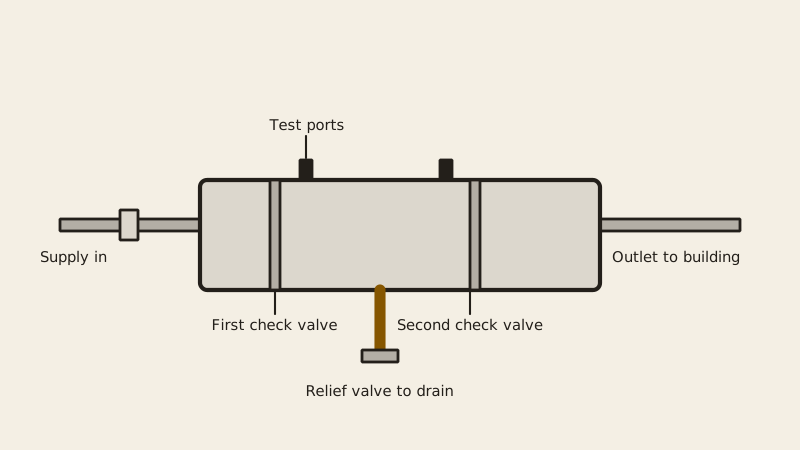
A shop, restaurant, office park, medical suite or warehouse in Rancho Cucamonga may have a backflow assembly bolted to its water line. If so, a qualified tester has to check it regularly, with the outcome reported to the water district. A local plumber can run the test through us, and the price reaches you in writing beforehand. It sits under commercial plumbing. On the quote page, give the address, how many assemblies you have, and anything printed on the last test tag.
What does commercial backflow testing actually involve?
The tester hooks a test kit gauge to small ports on the assembly and works through a set order of pressure checks on each check valve plus the relief valve. Pass or fail goes on a report. Supply to the building stops for a spell, which matters to any business that cannot lose water at noon.
Why bother? An assembly stops used or polluted water from sliding back into the public mains. The Cucamonga Valley Water District customer FAQ names two triggers. Backsiphonage follows a sudden pressure loss in the district's pipes. Backpressure is the reverse: the building's own plumbing outmuscles the district's mains. Boilers, landscape irrigation, sprinkler risers and chemical processes are typical culprits.
A visit usually runs in this order:
- The tester notes the make, model, size and serial number, and confirms the ports can be reached.
- The building supply is closed, the gauge goes on, and the internal valves are tried one by one.
- A failed rubber part can sometimes be swapped on the spot and the device tried again.
- Readings and the result are written up, and the district receives its copy.
Which commercial properties need a backflow assembly?
The water district makes that call property by property. Cucamonga Valley Water District says it notifies a customer when a connection could foul the drinking supply, and that high-risk commercial, industrial and residential customers must install, test and maintain an approved assembly. Look through your account mail for a notice.
Properties that most often get one include:
- Restaurants and food service, because of carbonators, dishwashers and mop sinks.
- Irrigated landscaping on commercial lots, such as the planted strips around shopping centers.
- Fire sprinkler lines, which hold standing water for months.
- Medical, dental and laboratory buildings.
- Car washes, laundries and industrial sites with chemical mixing.
- Apartment and mixed-use buildings with shared irrigation, boilers or pools.
If your building sits in a part of the city served by a different supplier, the rules and the approved tester list may differ. Rancho Cucamonga is mostly inside Cucamonga Valley Water District, but a few edges, notably near Etiwanda Avenue, may fall into another water company. Your water bill shows who your supplier is.
Why do backflow test prices vary?
A plumbing company's published guide lists an annual test at roughly $75 to $250 for each device, dropping to $50 to $150 each when three or more are done at once. Device size, type, access and filing paperwork shift the figure. The source is a Bay Area contractor, so quotes in Rancho Cucamonga can differ.
| Item | Typical range (published guide) |
|---|---|
| Annual test, single device | $75 to $250 |
| Annual test, three or more devices, each | $50 to $150 |
| Small repair after a test failure | $150 to $500 |
| Major repair or replacement | $800 to $3,000 or more |
| New RPZ or double check installation | $2,500 to $8,000 |
What pushes a quote up:
- Access. An assembly in a ceiling, a vault or a locked mechanical room costs more time.
- Size. Large fire-line assemblies take longer than a one-inch irrigation device.
- Condition. A device that fails on rubber parts is a modest repair; a corroded body is a replacement.
- Deadlines. A test squeezed in just before a district cutoff can cost extra.
Read those as a published guide and nothing more. Your actual price will be on the written quote that a local plumber prepares after seeing your devices.
Beyond testing, what do commercial plumbers do?
Testing is a small slice. A commercial plumber deals with big supply lines, banks of restrooms, grease traps, mop sinks, building-size water heaters, drains serving dozens of fixtures, and kitchen or laboratory hookups. Scale, stricter code and the pressure to keep a business open set it apart from a house call.
A few pieces of that work appear alongside backflow in practice:
- Pressure regulation, because high supply pressure shortens the life of everything downstream.
- Emergency response for burst lines and sewer backups, which the emergency commercial plumber page covers.
- Planned maintenance on water heaters and drains so that failures do not arrive on a Friday afternoon.
- Installing and replacing assemblies when a district asks for a new one.
If you are comparing quotes, commercial plumber hourly rates explains how the bills are built. Residential readers will find the general rate guide at what a plumber costs.
Who can legally test an assembly?
Only someone the district accepts. Cucamonga Valley Water District states that testers must be on its approved list to test or repair assemblies in its area, and that the signed original of the test report must go back to the district. A published guide adds that testers hold a current credential from a body the state water board recognizes.
In practice that means three checks before you book anyone:
- Ask for the tester's name and credential, and confirm it with your water supplier.
- Ask who files the report, and by when. Some districts want it within days.
- Ask how a failed assembly is handled, and whether the quote already includes a retest.
A contractor license is a separate matter. California asks for one on any job above $1,000 combined, or any time a permit is involved, and swapping a large assembly can pass that mark. Verify a contractor on the CSLB website.
What if the device fails, or nobody tests it?
Failure means repair and a retest, and the guide we read says districts often allow about 30 days. Ignore testing and the notices get firmer. The same guide lists service shutoff as a last resort and fines of $100 up to well beyond $1,000 per device. Your supplier can tell you its actual terms.
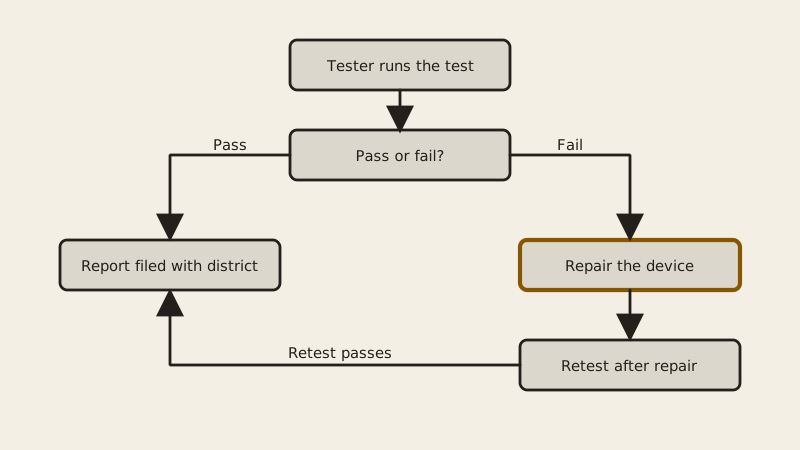
For a business, the practical costs are more disruptive than the fine. A failed test can hold up a lease renewal or a sale. A failed fire-line assembly can leave a building without protection while parts are on order. A leaking relief valve discharging water outside may be the first sign of trouble, and it is worth reporting before the next test date.
Common questions
How frequently does the test come around?
The guide we read says every year at minimum, with some districts asking more often for high-hazard connections. The Cucamonga Valley Water District FAQ gives no frequency, so read the notice on your account or phone the district. Keep every report: buyers and insurers sometimes want the history.
How long will the water be off during the visit?
One assembly that is easy to reach often takes under an hour, paperwork included. More devices, tight access or a repair stretch that out, so book for closing time, a shift change or another quiet window. Water is off in the building during the readings.
What helps the tester on the day?
The location of every assembly, the last report or tag, and any district notice. Unlock the room and clear the path to the device. Know where the building shutoff is. Warn staff that water will drop out briefly so nobody is caught mid-rinse.
Can a restaurant or retail tenant order the test, or is it the landlord?
That depends on the lease. Often the landlord owns the irrigation and fire assemblies, and the tenant owns equipment inside the unit, such as a carbonator or a boiler. Read the lease and ask the district whose name the account is in. A written quote should name who is paying.
Every service and price guide is on plumber in Rancho Cucamonga.
Updated