Every leaking faucet has a tell. Water beading at the spout, a wet collar around the handle, a puddle under the vanity, a spigot that weeps on the lawn: each one blames a different part. Sort the symptom first and the repair follows. Part of the wider faucets, sinks, showers and disposals section of this site. A drip that survives a repair kit belongs on the quote page, where a local plumber visit can be set up.
Where is my faucet actually leaking from?
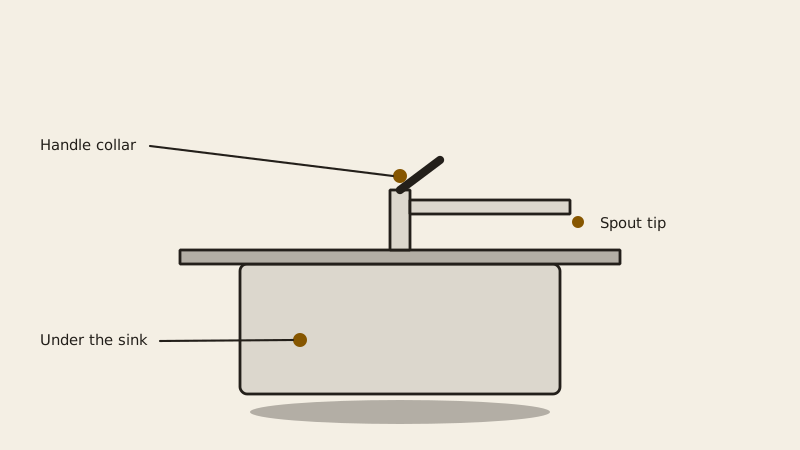
Inspect three spots before reaching for a tool: the end of the spout, the collar where the handle meets the body, and the cabinet floor. A spout drip blames the internal seal. A damp collar points at a rubber ring or packing gone stiff. A pool in the cabinet may belong to a supply hose or compression nut, so the faucet could be innocent.
Wipe all surfaces dry, let the water run briefly, shut it off and shine a flashlight along every joint. Tissue wrapped around the supply lines is a handy detector, since it darkens exactly where the moisture is.
What the symptom usually means:
| Where it leaks | Likely culprit |
|---|---|
| Spout, even with the handle shut | Cartridge, washer or valve seat worn through |
| Spout base, only while running | Cracked body or a loose swivel O-ring |
| Around the handle | Handle O-ring or packing |
| Under the sink | Supply line, compression nut or drain connection |
| Every faucet in the house drips | Scale on the seats, or pressure running high |
What is inside the faucet I am holding?
Faucets fall into four families: compression (two handles that screw down), cartridge (one handle or two that turn a quarter), ball (one handle over a rounded cap) and ceramic disc (one handle on a wide cylindrical body). Each leaks differently, and each takes a different part. Knowing the family stops you buying the wrong kit.
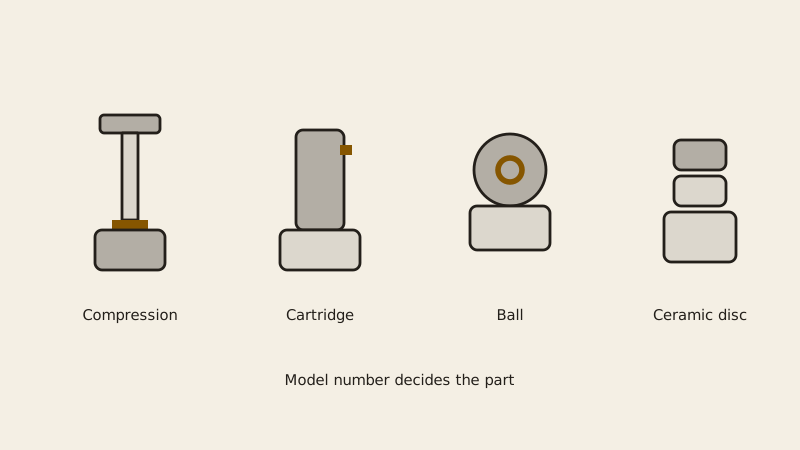
Quick identification: a handle that tightens down against resistance is compression. One that swings side to side over a dome-shaped cap is probably a ball faucet. A handle that rises and falls smoothly on a single wide cylinder is likely a ceramic disc. The rest are cartridge designs, which is most faucets built in the last few decades.
Manufacturers such as Delta and Moen sell cartridges that look nearly the same but do not interchange, so the model name matters more than the shape. Look on the underside of the spout, the body, or inside the handle for stamped lettering. If there is no mark, carry the removed cartridge to the store for a side-by-side match.
How do I swap the worn part in a sink faucet?
Turn both supply stops clockwise, crack the faucet open to let the pressure out, and cover the drain with a rag. Lift off the handle, then whatever nut or clip holds the guts in, then the tired part. The replacement goes in facing the same way. Photograph each stage on your phone so reassembly is not a guessing game, and open the stops slowly afterward.
Details by family:
- Compression. Lift the stem out. The black washer on its tip is usually flattened, so replace it with its screw, and replace the small O-ring around the stem. If the seat in the body looks scored, a seat wrench can dress it.
- Cartridge. Grip the cartridge with pliers and draw it out, then lower in the new one, lining its tab up with the slot. A cartridge that will not move is probably cemented in by scale.
- Ball. Kits include springs, rubber seats and O-rings in one package. Replace them all.
- Ceramic disc. Swap the whole disc cylinder, after cleaning the ports.
Rancho Cucamonga water explains why scale is often the culprit. The Cucamonga Valley Water District 2025 report shows total hardness between 109 and 142 ppm, so minerals bake onto seats and into cartridges. If a new washer still drips, a rough seat is the first thing to suspect.
Is a tub or shower valve different to repair?
The logic is the same, except the valve hides in the wall. With the handle and trim plate gone, the stem or cartridge is exposed. If no stop valve sits near the tub, the house main has to be closed first. A new cartridge or fresh stem washers usually ends a spout leak.
Things peculiar to tubs:
- A tub spout that drips while the valve is off points to the valve itself, not the spout.
- A pull-up diverter knob can fail alone. Water then pours from the shower head while the tub is running.
- A stuck handle that will not shut the flow tends to mean a seized cartridge. A puller tool is sometimes needed.
- Staining or a soft spot in the wall means the leak is inside it. Stop, and read about a shower leak plumber. The longer walk-through for tubs is fixing a leaky tub faucet.
My outdoor hose bib drips. What now?
Start at the handle. Water seeping from behind it often stops with a small nudge on the packing nut. Dripping from the spout itself means a worn washer. Shut the supply, pull the handle, fit a new packing or stem washer, then test with the hose off.
What else to watch outdoors:
- Hose left attached. A connected hose holds water in the bib and keeps it dripping.
- Vacuum breaker. The little cap at the spout of many hose bibs lets a few drops out when the water runs, which is by design. It becomes a leak only when it sprays constantly.
- Frost-proof bibs reach through the wall on a long stem. If the wetness comes from that stem behind the wall, call a plumber.
- High pressure wears spigots out. Higher ground can mean higher pressure, though no verified local figures exist, and checking the pressure regulator helps when several fixtures drip.
At what point does a faucet leak need a pro?
Put the wrench down in four cases: a shutoff stuck open, a part that snaps as it comes out, water escaping inside a wall, or a drip that outlasted a new part. None of those is only a seal now. A seat, or the entire valve body, may need replacing, which a plumber can usually handle in one trip.
Do not shrug off a drip. Households lose upwards of 9,300 gallons to leaks each year, EPA reports, and dripping fixtures contribute. The reasons a bill climbs are listed in the water bill guide.
Across Rancho Cucamonga, Upland and the foothill streets, a plumber travels to you. If the sink, disposal or drain is acting up too, say so in the same request. Permit work and main supply line repairs fall to a plumber with a California contractor license. More services are listed from the home page.
Common questions
Why does the faucet drip after I changed the washer?
Almost always the seat is pitted or coated in scale, so even a new washer cannot press flat against it. A mismatched washer, or a cracked stem O-ring, causes the same drip. A seat wrench can dress many seats. A seat that will not turn should go to a plumber.
Can I leave the water on while I work?
No. Pull a cartridge on a live line and a jet of water follows, with you sprinting for the main. Turn the sink stops, or the main for a tub or spigot, then run the faucet until only air comes out.
How long does a faucet repair take?
Plan on 30 to 60 minutes when the correct part is already in hand. Store runs, stuck handles and scale stretch that. A plumber tends to be quicker, with tools and common parts on the truck. Tub valves and damaged seats lengthen any estimate.
What is worth asking a plumber before a faucet visit?
Is the price a flat sum or hourly? Is there a charge just to show up? Are parts inside the figure? Past a simple seal, ask whether a permit is involved. Have all of it on paper before anyone starts.
Updated