Start with the headline number. The 2026 guide I read says most whole-house repipes land somewhere in a $4,000 to $15,000 band. Its typical figure is $7,500, quoted for a home of 2,000 square feet with two baths and standard access. Copper is the expensive path and PEX the thrifty one. Opening and closing drywall is what swings the total. If you want the job explained, go to repiping and pipe replacement; this page sticks to money. We book the visit, someone local comes to measure, and the written number reaches you before work gets scheduled.
What would a 1,200 square foot house cost to repipe?
Multiply the guide's per-square-foot rates and you get about $2,400 to $6,000 for PEX and $4,800 to $10,800 for copper. Those two ranges are my own arithmetic, not printed figures. Real quotes on small houses often sit above the arithmetic, since fixture count and minimum labor barely shrink with floor area.
A one-bath house with a kitchen close by can sit near the low end for PEX. A second bathroom pushes up faster than the extra square footage suggests: the guide says each bathroom adds about fifteen percent, because fixtures crowd into little floor space.
How do PEX, CPVC and copper compare per square foot?
For material and labor together, the same guide lists PEX at two to five dollars a square foot, CPVC at three to six, and Type L copper at four to nine. Other sites print bigger numbers, so per-foot math works as a yardstick and nothing firmer. Copper costs roughly double PEX in every comparison I saw.
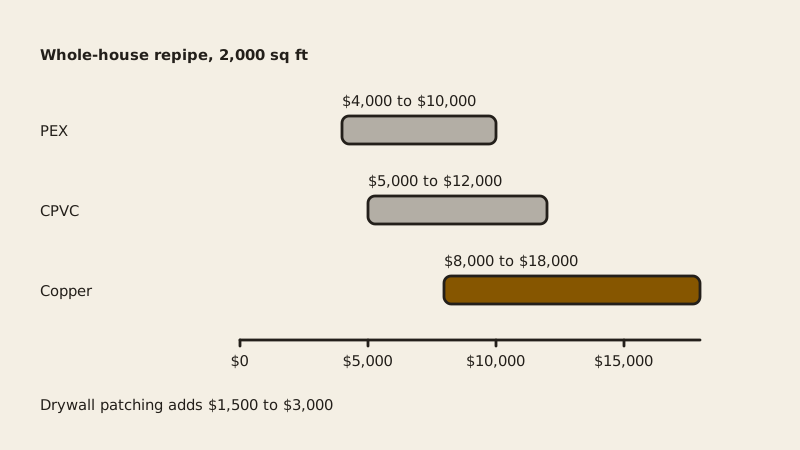
Back to that 2,000 square foot house. In the guide, PEX totals $4,000-$10,000, CPVC runs $5,000-$12,000 and copper tops the list at $8,000-$18,000. Wall repair, drywall and paint, comes on top whatever the pipe, in a band of $1,500 to $3,000. The trade-offs behind those materials are in PEX versus copper.
Does a bigger or two-story house change the math?
Yes. The guide puts a 3,000 square foot home about half again above a 2,000 square foot one. Applied to its PEX range, that suggests roughly $6,000 to $15,000, which is again my own multiplication. Slab floors and upper stories lengthen the labor.
Local housing shapes the picture. In ZIP 91739 around Etiwanda, Census figures show 5,597 of 12,512 homes built in the 2000s. In Alta Loma's ZIP 91737, 3,992 of 8,340 date from the 1980s. Some of those houses carry aging copper and some have newer plastic lines that need nothing, so a plumber should look before anyone assumes a full replacement.
Which details raise or lower a repipe quote?
Five levers do most of the work: how much drywall comes off, one story or two, concrete slab or raised floor, which pipe goes in, and how many fixtures need feeding. Old galvanized steel adds hours because it resists removal, and a permit adds scheduling time.
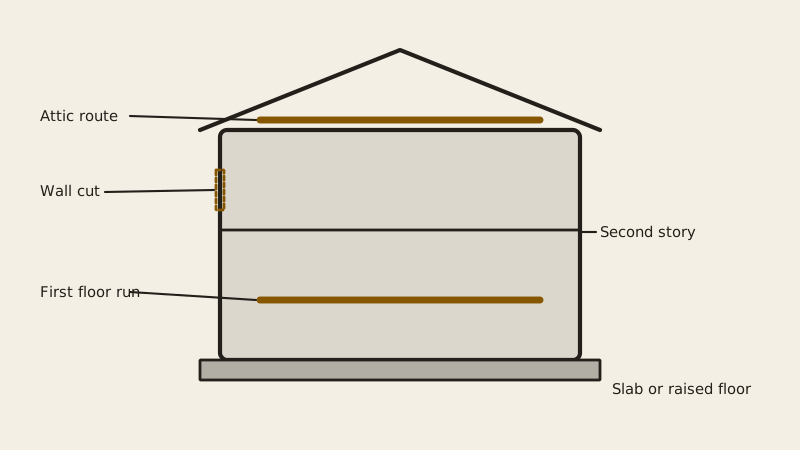
Some plumbers pull PEX through attics and crawl spaces and leave most walls whole. That is why two bids on one house can differ by thousands of dollars. Ask each bidder how many access holes they expect and who does the patching and painting. Homes from the 1960s and 70s hold more surprises, and what it costs to replace plumbing in an old house goes into the extras.
Is the old copper worth anything as scrap?
A little, but I will not print a per-pound figure. Scrap prices move every day and I found no source that stays accurate for long. Whatever the pipe fetches will be small next to labor charges. If you want the old tubing, say so before the job, and check with a local scrap dealer for the current rate.
What do repipe quotes often leave out?
Gaps tend to be drywall texture and paint, permit fees, reconnecting the water heater, and a new stop valve under every sink and toilet. A quote reading only "repipe, $X" invites a dispute later. Ask if the price reaches a finished wall or stops at the plumbing, and have the answer written down.
Two more to raise: whether hauling away old pipe is included, and how a corroded section missed on the first look would be handled. Good bids set a price for surprises or at least explain how change orders work, so you know the rules before the first cut.
When is a full repipe the wrong choice?
When the trouble is one stretch of pipe. A partial replacement or spot repair costs far less. What tips the decision is the leak history: three pinholes in one line over five years is a pattern, while a single failure after thirty years is just a repair. The steps of a repipe job are laid out separately, and for pipes beneath a floor slab, repairing a slab leak versus repiping applies.
A whole-house repipe is well beyond the size of job California allows without a contractor license, so run the contractor's name through cslb.ca.gov first. Put bids side by side on scope, because the bottom line alone misleads. Every dollar figure on this page comes from a national guide and applies loosely. Your house gets its real price in the written quote.
Common questions
How many days without running water should I plan for?
Where walls are reachable, count on a few days of pipe work, then drywall repair and paint. The taps are dry for much of that stretch, and the plumber will plan the shutoff days with you. Bigger homes, slabs and two stories stretch the schedule. Ask for the sequence in writing so you can arrange showers and laundry elsewhere.
What should a repipe estimate say in black and white?
It should state the pipe type, the count of walls opened, whether permit, patching and paint sit inside the price, the shutoff schedule, and any workmanship warranty. Before signing, confirm the contractor's license through the state's lookup, and file your copy of the estimate somewhere safe.
Is anyone required at home during the repipe?
Yes, early and late: somebody must unlock rooms, agree where walls get cut, and walk through the result. Between those moments, many owners head to work, though every room with a fixture must stay accessible. Settle the schedule beforehand, and confirm times the day before.
Can a repipe be done in stages to spread the cost?
Sometimes. The worst line can go first, with the remainder following on a later visit. Staging usually adds to the total because setup repeats. Ask for one price on the whole job and a separate price for phase one, then compare the two before choosing.
For what the work involves beyond the price, see Rancho Cucamonga plumber.
Updated