Two separate problems hide under this title. In the bathroom, the faucet keeps weeping after you shut it off, and the culprit is a small part inside the valve. In the kitchen, a pipe below the sink leaves a ring in the cabinet, and the culprit is a joint. Different diagnosis, different tools, and a rule common to both: close the water supply first, always.
Fixture repairs in general sit under the hub for faucets, sinks, showers and disposals. This guide narrows to the tub, the shower and the sink trap.
Why will the tub faucet not stop dripping?
Something inside the valve no longer seals. Older two-handle faucets use rubber washers pressed against a seat; a single lever faucet has a cartridge in its place. When either wears, water seeps through while the handle is closed. Scale speeds up the damage, and with CVWD reporting 109 to 142 ppm total hardness for 2025, crust is a fair bet here.
The cost of ignoring it is measurable. EPA arithmetic: a steady drip each second is 3,000-plus gallons a year at a spout, and a showerhead dripping ten times a minute is 500-plus. Sink faucets get their own page, leaky faucet fixes.
How should I prepare before starting?
Find the main shutoff, set out towels and a bucket, cover the drain with a rag in case a screw escapes, and photograph each stage. Many tubs lack their own stop valves, in which case the entire house gets shut off.
The law matters too. Under California rules a contractor becomes necessary at a $1,000 job, or at any job with a permit. These repairs fall well beneath that, yet opening a wall or touching the main supply could bring in a permit through Rancho Cucamonga's Building and Safety division. Unsure? Pause and ask before cutting.
How is a Moen cartridge replaced in a tub or shower?
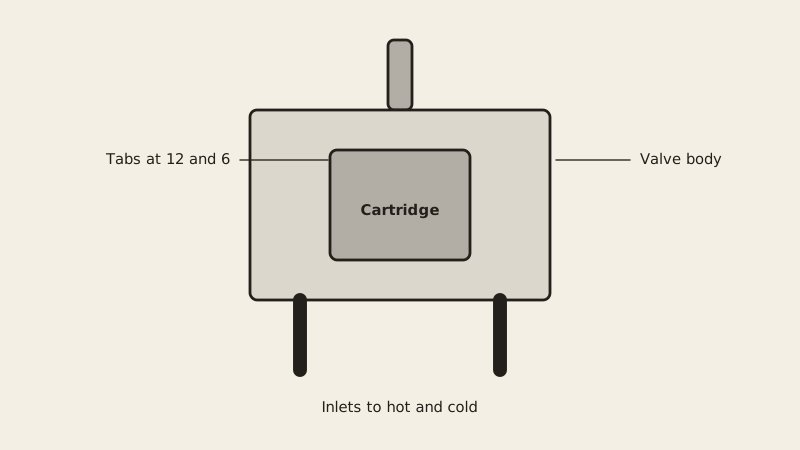
Moen's published steps for the 1225 single-handle cartridge run like this. With supply off, slide the stop tube straight off and remove the D-shaped washer from the stem. Raise the tab on the copper clip and take it out by hand, keeping it from falling into the wall cavity. The plastic wrench packed with the cartridge turns it a quarter, after which pliers draw it out.
Scrub the valve body clean first. Feed the new cartridge in so its plastic tabs sit centered on the slots at 12 and 6 o'clock, push the clip back without force, and point the stem's small notch down. Hot and cold swapped? Moen says to rotate the stem half a turn. The water stays off until the clip is seated. Other models take other parts, so match yours.
Where is the leak under my kitchen sink coming from?
Dry each joint with a paper towel, run the water, and watch which spot darkens first. Usual suspects: the big slip nuts on the trap, the supply hose to the faucet, and the disposal connection. A nut nudged tighter by hand often ends a trap drip, while a cracked trap or split hose is better replaced than patched.
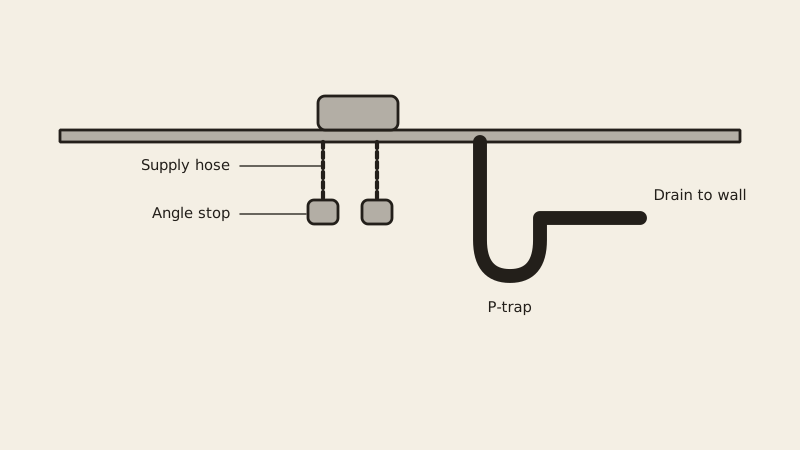
On a trap, set a bucket below, back the nuts off, inspect the rubber washer and its facing, reseat and snug. On a hose, close the angle stop and fit a new one. Thread tape suits threaded joints and will not fix a crack. Corroded joints or a leak at the wall stub-out deserve a plumber; a blocked basin may be a kitchen sink clog at the same time.
What is the general routine for a dripping tub faucet?
Kill the water, relieve the line, strip the handle, pull the worn part, clean, rebuild with a matching new part, and test. Closing the fixture stops works when the tub has them; if not, the main valve has to go off. Run the handle open afterward to confirm nothing is flowing before you dig in.
Bring the old washer or cartridge to the shop so the replacement matches exactly, and snap photos as pieces come off, because rebuilding is the part that goes wrong. A frozen handle or a stem fused to the body is the point to stop: forcing it can damage pipe in the wall. A valve that never fully shuts is plumber territory.
Cartridge stuck, or the drip came back: now what?
Scale can weld a cartridge in place. The answer is a purpose-made puller, not brute force; Moen offers one for its single-handle 1200, 1225 and 1222 cartridges. If the drip survives a new cartridge, suspect a worn valve body, or the showerhead arm, or a joint inside the wall.
Dampness on a ceiling or wall near the tub points behind the surface, which is not an owner repair. Stop using the fixture. The shower leak page explains that case, and weak shower pressure is the page for flow complaints after a repair.
Time for a plumber business?
Bring one in when shutoffs leak, a handle or stem will not release, damp spreads on a wall or ceiling, or a second attempt fails. Replacing the whole valve is larger than swapping a cartridge. Planning a new fixture? Faucet installation cost gives budgeting context.
Wider cases are on leak repair. To arrange a visit, use request a quote. See the full range of work from the home page.
Common questions
Is a cartridge swap a short job?
For an owner with the right part and the water off, it is generally brief, but a seized cartridge or a stuck handle stretches it, and that fixture is out of use until you finish. A plumber can estimate hours after seeing the valve type and its condition.
What belongs on a quote for a tub faucet leak?
Whether it covers cartridge or washer plus trim, whether a failing valve body might need replacing, and what happens if the shutoffs fail. Also ask about opening the wall behind the tub and who repairs tile or drywall. CSLB's website lets you check a contractor's license number.
Is someone needed at the house?
Usually. The plumber needs the room opened and unlocked, and if the house supply gets shut off for a spell, someone should know. Watching the final test is wise because it confirms the drip has actually stopped, and extras such as a new valve should get your approval first.
Why are hot and cold backwards after my cartridge swap?
The cartridge went in rotated. For the Moen 1225, the maker says turning the stem 180 degrees corrects reversed hot and cold. Turn the water off again, take off the handle and stop tube, and rotate it. Read the instructions for your own model, because other cartridges differ.
Updated