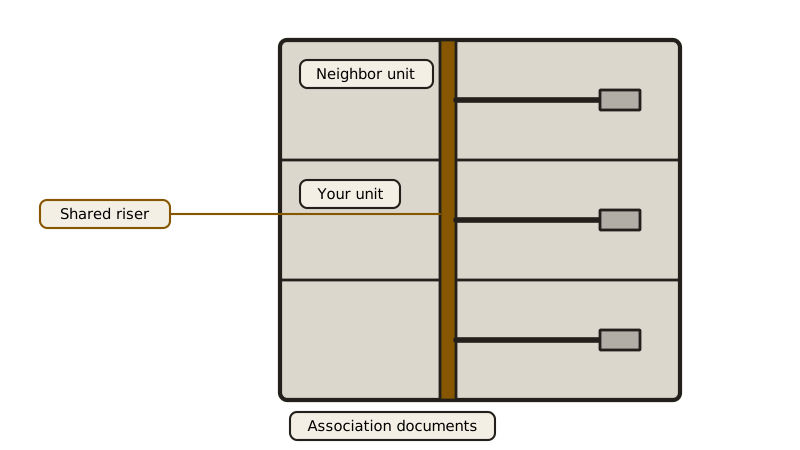
Shared plumbing is common in Cucamonga. ZIP 91730 counts 26,697 housing units, and 8,875 of them are in structures with five or more units, so one pipe can serve several households. House ages run across seven decades. Other parts of town are covered in the neighborhood guide.
Why is plumbing in Cucamonga so often a shared problem?
Because roughly one home in three in ZIP 91730 is in a structure of five or more units, going by American Community Survey counts on Census Reporter. A further 3,212 are attached townhomes or condos. A leak in a shared wall, riser or drain line can involve neighbors and an association, not just one owner.
That changes the order of operations. Before anyone books a visit, it helps to know whether the failing pipe belongs to your unit or to the building. Association documents usually say where your responsibility ends, commonly at the walls of the unit, though each set of documents differs and we would not guess for you. When the drip is coming through a ceiling below a neighbor, the ceiling leak guide lists what to do first.
Single-family streets exist too, so the same neighborhood can hold a 1950s ranch house and a 2000s townhome a mile apart.
What do the homes in Cucamonga look like behind the walls?
They fall into three eras. Census figures for ZIP 91730 show 446 homes built before 1940, 1,232 from the 1950s and 6,196 from the 2000s. Each era brings its own pipes and its own failure pattern, so the age of the address tells a plumber where to look first.
The oldest group is where you can still find galvanized steel supply lines, whose bore shrinks as mineral crust grows inside. Lower pressure at one faucet and rusty water on first use are the usual hints. The 1950s group is often where copper has been added in patches over time. The 2000s group is mostly copper or PEX supply with plastic drains, and trouble there tends to be a fitting, a water heater or a fixture rather than the whole system. If you are weighing a full replacement in an older place, read galvanized pipe replacement and the figures in the old-house replacement cost guide before deciding.
Foothill Boulevard, the old Route 66, runs through the community, and some of the oldest lots sit near it. Treat the street history as color, not a rule: the year of the individual house is what counts.
Which water district covers Cucamonga, and is the water hard?
The Cucamonga Valley Water District (CVWD) supplies water here, and its office is on Ashford Street in this very community. CVWD's 2025 testing put total hardness between 109 and 142 ppm, averaging 125.5 ppm, or about 7.3 grains per gallon after conversion. Kettles, shower glass and heater tanks tell the story at that level.
The grains figure is our own calculation from the report, using the standard conversion of 17.1 ppm per grain. CVWD's own FAQ describes its water as moderately hard to hard and gives a wider band, 81 to 190 mg/L. The two numbers measure different things (one year of tests against a general description), so each is quoted with its source rather than blended.
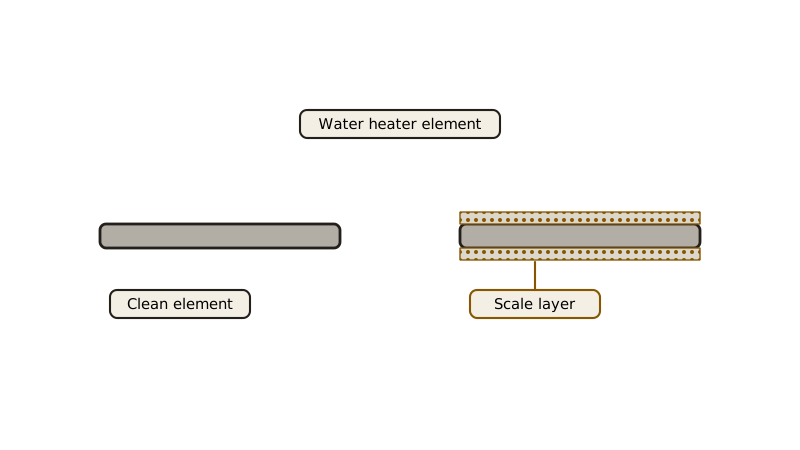
What does that mean in a Cucamonga kitchen or bath? Scale builds up on heating elements, in tank water heaters and in aerators. If a faucet spray has gone ragged or a water heater is noisy, mineral deposit is a likely cause. A water softener installation is the long-term answer for some homes. Customers can call the CVWD water quality coordinator at (909) 987-2591 with questions about the report.
The district's service area also touches parts of neighboring cities, so if you are near a boundary, your water bill shows who supplies you.
Where does sewer responsibility change hands in Cucamonga?
CVWD runs wastewater too. It maintains about 421 miles of collection main, 8 to 36 inches across, with roughly 38,000 sewer connections. Per its FAQ, ownership passes to you at the property line: the lateral running to the house, the cleanout and the back-water valve are yours.
So a main that backs up the whole street is a district matter, while a blockage between the property line and your house is yours. For a condo or townhome, the association may own the lateral, and again the documents decide. A plumber visiting a repeated backup will look at the cleanout first, since that is where responsibility is usually settled.
Natural gas comes from Southern California Gas Company, and its list of communities served names Cucamonga. Smell gas and the first move is outside, then the SoCalGas odor line (1-800-427-2200), with 911 behind it. Gas piping work is reserved for contractors holding the right California license.
What do permits in Cucamonga involve?
Rancho Cucamonga's Building and Safety Services, part of Community Development, handles permits for the whole city, Cucamonga included. The city does not issue permits over the counter, and the process runs entirely online. Permitting questions can go by text or phone to (909) 488-4668.
Inspection questions have their own line, (909) 477-2710, with hours of 7:30 am to 6:00 pm listed by the city. The city's pages give phone and email hours of Monday to Thursday, so a Friday request waits for Monday. Permit work carries a contractor-license requirement in California, so ask who is filing.
A new water heater, a repipe or any gas pipe change often needs a permit, so check with the city building division; water heater replacement costs have their own guide.
What moves the price of a plumbing visit in Cucamonga?
Three things matter most here: access, building type and pipe age. A unit in a multi-family building may need coordination with an association or building manager before anyone opens a wall. An older single-family house can eat time on brittle fittings. A 2000s townhome usually does not.
We do not publish prices for this area because no source we checked covers it. Each job is quoted after a visit, in writing, before work starts. General ranges live on the plumber cost page; note that scale from the local water can shorten the life of heaters and fixtures, which in turn changes what is worth repairing.
A regulator that has failed open loads these older fixtures too; the regulator adjustment guide says what an owner may check and where the job becomes a plumber's.
How do I book a Cucamonga visit?
The quote form takes an address and a short description, or ring on a weekday between nine and five. The visit happens at your door and the price reaches you on paper first. Say whether you own a single unit or the whole building, since that settles who approves the job.
For an urgent flood or burst line, read the emergency page and close the main valve first. Back on the home page, Cucamonga Peak Plumbing lists every service we arrange across the city.
Common questions
Is there a set price for Cucamonga jobs?
No single figure exists for Cucamonga. Condo risers, 1950s lots and 2000s townhomes each price differently, so the number is written after someone sees the job. The plumber cost page covers the general ranges and what moves them; read it before you phone.
Do city permits apply to plumbing work in Cucamonga?
Often. Rancho Cucamonga's Building and Safety Services handles them online for the entire city, and typical triggers are a new heater, a repipe or gas work. Whoever quotes the job should say who files, and you should keep the final inspection record.
What if a neighbor's unit is leaking into mine?
Begin with the building manager or association, because shared walls and risers are usually theirs to inspect. Close the valve to your own unit if you can, take photos and note the hour it began. The plumber then checks your side. Who pays depends on governing documents we cannot see.
Sources used
- Census Reporter, housing units by year built and units in structure
- Cucamonga, California (Wikipedia)
- Cucamonga Valley Water District, About Us
- Cucamonga Valley Water District, wastewater
- Cucamonga Valley Water District, FAQ
- CVWD 2025 Water Quality Report
- SoCalGas cities and communities served
- City of Rancho Cucamonga Building and Safety
Updated