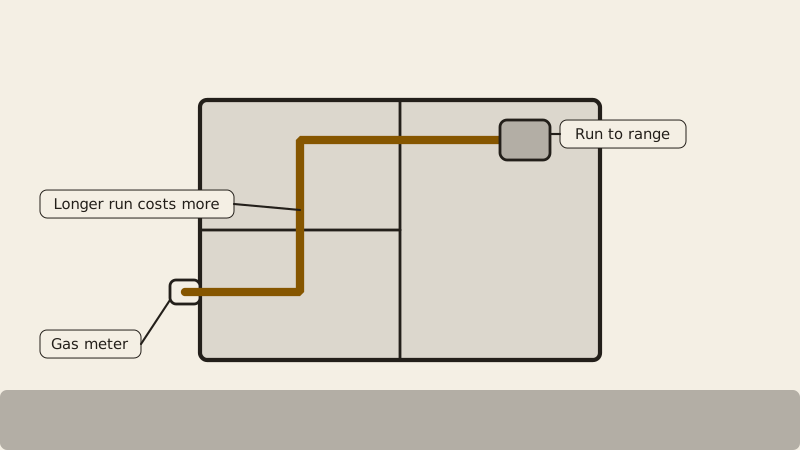
Published figures for gas piping are wide because the jobs are. A short hookup behind a stove costs a fraction of a buried run across a yard. This page gives the ranges two national guides print, explains what moves them, and says where I could not find a number. It belongs with the main page on gas line work. When you want a real price, use the quote request.
How much does it cost to replace all the gas lines in a house?
I could not find a verified figure for whole-house gas replacement, and none of the guides I read prices it. It depends on how many appliances you have, the pipe length from the meter, and wall access. A guide's gas installation average is $558, but replacing every run costs more than one hookup.
Think of it as several jobs stacked together. One national guide lists gas line installation at $120 to $1,350, appliance runs around $15 to $25 per foot, and trenching at $4 to $12 per foot. A whole-house replacement adds an inspection, wall repair and a permit. Ask any plumber to price each appliance run on its own line so you can compare bids.
What are typical gas line prices?
One guide gives a range of $120 to $1,350 for installation, with a national average of $558. It lists dryer and stove runs around $20 per foot, fireplaces at $15 to $25 per foot, and a 30-foot stove hookup near $600.
| Job | Published range |
|---|---|
| Gas line installation, total | $120 to $1,350 |
| Installation average (national) | about $558 |
| Run to dryer or stove | about $20 per foot |
| Run to fireplace | $15 to $25 per foot |
| Trenching | $4 to $12 per foot |
| Repair behind a stove | $120 to $250 |
| Repair in a crawl space or behind a wall | $270 to $760 |
| Repair of a buried line | $1,500 to $5,000 |
These are national guide figures, so use them as a rough measure only. The written quote from a local plumber who has seen your house sets the real price.
What pushes a gas line price up or down?
Length, route, depth, access, the number of appliances, pipe material, and the permit all matter. A short run in an open crawl space is cheap. A buried line under concrete, or through finished walls, is not. Slopes, rock or retaining walls can raise trenching costs compared with a flat yard.
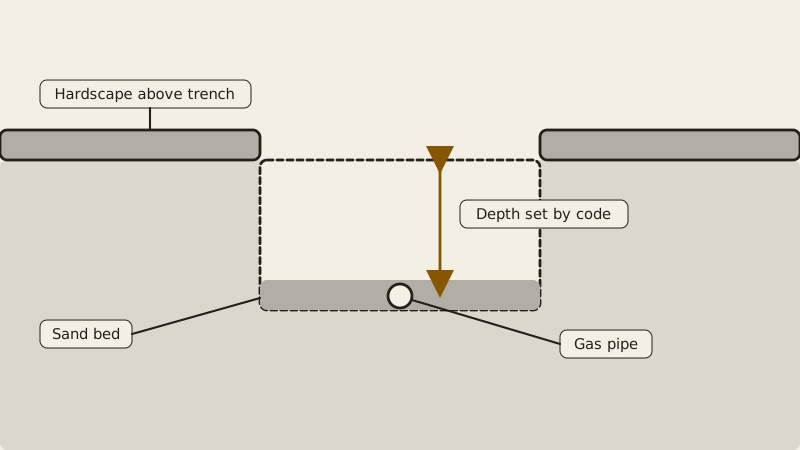
The drivers in more detail:
- Distance from the meter: more pipe, more labor, more testing.
- Trenching: priced per foot, and depth, soil and hardscape change the rate.
- Access: open framing is quick, finished walls need opening and repair.
- Appliance load: big loads may need larger pipe than the old line.
- Permit and inspection: new lines and changes usually need one. In Rancho Cucamonga the Building and Safety division processes permits online.
- Combustion air and venting: a gas appliance in a closet needs air and a vent, which can add work.
If you want the pipe replaced because it is old, the plumber will pressure test it first. A passing test can save the cost of replacement.
What does a gas plumber charge by the hour?
Gas work follows ordinary plumber rates. A national guide gives $50 to $100 an hour for journeyman plumbers and $75 to $200 for masters, plus a service fee. Note that "Gas Safe" is a UK register, and in California the requirement is a contractor license.
California requires a contractor license for jobs of $1,000 or more in labor and materials and for any job that needs a permit, which includes new or changed gas piping. Ask for the license number and look it up on the Contractors State License Board site. Hourly figures apply only to some jobs, since many gas jobs are quoted as a flat price per run.
How much does an earthquake gas shut-off valve cost?
I could not verify an installed price for an earthquake shut-off valve, so I am not quoting one. The price depends on the valve type, the pipe size and whether a permit applies. Ask the plumber to list the valve and the labor separately, and see the page on earthquake gas shut-off valves.
A valve is a safety item, and the work is gas piping, so it should be done by a contractor and checked. Do not buy a valve without confirming it suits your meter and local rules. Ask the plumber how the valve is tested after installation.
What is a gas pipe connector, and does it cost much?
A gas pipe connector is the short flexible line that joins an appliance such as a stove or dryer to the rigid pipe. The part itself is cheap next to the labor, and I could not verify a price. They wear out and are usually replaced when the appliance is.
Do not reuse an old connector on a new appliance, and do not bend or kink one. Replacement is gas work, so leave it to a contractor. If you smell gas, leave the building and phone SoCalGas on 1-800-427-2200 from outside, or 911 if you cannot reach them. The cost of fixing the connector is small compared with the risk of ignoring a leak.
Common questions
How much does a plumber cost to fix a pipe?
For a gas pipe, one guide lists $120 to $250 for a repair behind a stove and $270 to $760 in a crawl space or wall. A buried line runs $1,500 to $5,000. Water pipe repairs differ, so see the plumber cost guide.
How long does a gas line job take?
A hookup or a short repair is often a few hours. A new line with trenching or wall work can take a day or more, plus time for the permit and the city inspection. Ask the plumber for a schedule that includes the inspection date, since gas often stays off until it passes.
What should I ask before I hire someone for gas line work?
Ask for the contractor license number and look it up, whether the permit and inspection are in the price, what pipe is used, how the line is pressure tested, and what happens if the plumber finds a second problem. Get the answers written into the quote.
Do I need to be home for gas line work?
An adult should be there at the start to show the appliance and the meter and to approve the written price. Gas is shut off during the work and restored after it, so plan to be home for the inspection and for relighting pilots if you have any.
Prices are one part of the job: Cucamonga Peak Plumbing covers the rest.
Updated