Hear water trickling after the flush has finished? Find a damp ring on the bathroom floor? Either one is a repair that a local plumber normally handles in a single visit, and the part itself often costs less than lunch. We'll arrange that visit for homes across Rancho Cucamonga, Upland and the foothill streets, and the price lands in your hands before the first wrench turns. Start on the request-a-quote page, or read on to work out what is wrong.
What are the three common faults in a cistern toilet?
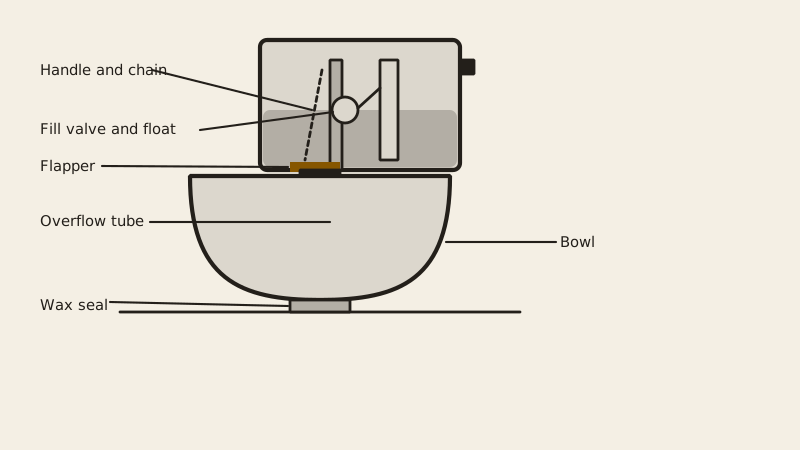
Flapper, fill valve and flush handle with its chain. A rubber flapper plugs the tank outlet. Another valve refills the tank. A handle and chain raise the flapper on demand. When any one of them tires, you get running water, hissing or a feeble flush. Under the bowl, a wax seal is the fourth suspect.
Read the symptom like a map:
- Trickle into the bowl, or an unprompted refill minutes after flushing: flapper not sealing. Toilet flapper repair covers that fix.
- Hissing, or water dribbling into the overflow tube: fill valve worn, or the float riding too high. See fill valve repair.
- You have to jiggle or hold the handle: chain slack, chain kinked, or a handle arm eaten by corrosion.
- Damp floor at the base: the wax seal, slack bolts holding the bowl down, or a supply connector that sweats.
Local water plays a part. Cucamonga Valley Water District reported total hardness of 109 to 142 ppm in its 2025 analyses, about 125 ppm on average. That is enough dissolved mineral to crust a flapper seat and gum up a float arm, so a toilet in the Rancho Cucamonga area can start misbehaving before the rubber is truly worn out.
Can I fix a broken toilet?
Tank parts, yes. Replacing the flapper or the fill assembly takes a screwdriver and a spare half hour. Floor leaks, a cracked bowl, a chewed-up flange or a wall stop frozen in place are a different story, and belong to a plumber.
To try the tank yourself, go in this order:
- Turn the wall stop clockwise until it firmly resists. Flush, and keep pressing until the tank has emptied.
- Inspect the flapper. Soft, curled or slimy means replace it. Measure the tank outlet, because 2-inch and 3-inch flappers are both common.
- Hook the chain so it droops with a finger-width of play.
- Open the stop gradually. The refill should cut off a little under the top of that central tube.
- Last, test for seepage. Add dye (a splash of food coloring does it) and step out for ten minutes. EPA's rule of thumb: colored water in the bowl equals a leak. Flush when you are done.
One caution. Chrome stops in older Cucamonga and Upland houses may not have turned in decades. Do not muscle a stuck one. If it breaks, shut the house main and ring a plumber.
What breaks most often inside a toilet?
Flappers, mostly. Rubber stiffens, curls and picks up scale, and one that no longer seats lets the tank bleed into the bowl. EPA wants flappers swapped on a five-year schedule at the latest. Its page warns that a worn one may waste thousands of gallons annually while making no noise.
That silence is the trouble. A toilet refilling itself twice a day barely whispers yet still pads the bill. When an invoice leaps for no reason, dye-test every toilet first, then read about other causes of a surprise water bill.
Fill valves rank second. Brass-and-float designs lose their seals; plastic ones jam when grit from the supply line lodges in the diaphragm. If you have swapped the flapper and still hear hissing, the fill valve is next in line.
Running toilet: what does the plumber's bill look like?
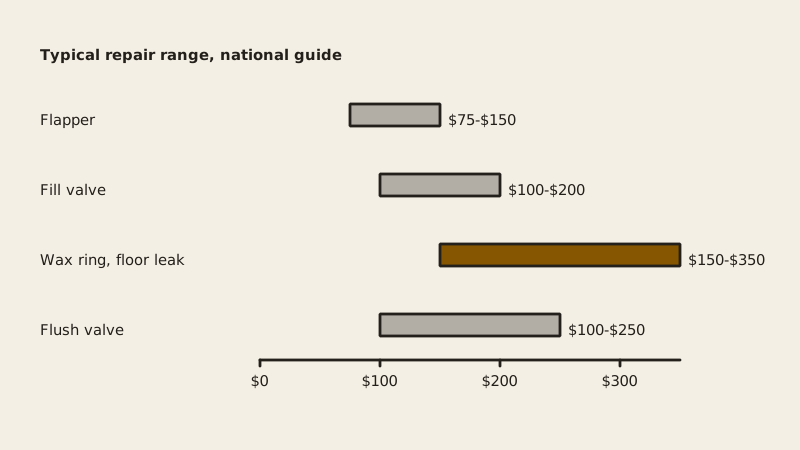
A national price guide lists the swap at about $75 to $200 in labor and part: a flapper falls at the low end, a fill valve a little higher. The call-out fee, the clock and the toilet's make all move the total.
| Repair | Typical range (national guide) |
|---|---|
| Flapper | $75-$150 |
| Fill valve | $100-$200 |
| Leaking supply connection | $75-$175 |
| Wax ring (floor leak) | $150-$350 |
| Flush valve | $100-$250 |
| Auger visit for a clog | $100-$250 |
The guide adds that local labor rates can swing these by about a fifth, that parts usually come on top, and that weekend or holiday overflow calls often add $75 to $200. A bad closet flange costs extra once the bowl is lifted. Those are published guide numbers only. Your actual price is whatever the local plumber's written quote says.
Now and then repair is the wrong spend. With cracked porcelain, or an ancient model you meant to retire, compare against replacement pricing first.
What other bathroom plumbing problems show up with a failing toilet?
Slow sinks, dripping faucets, thin shower flow, weeping supply lines and a gurgling drain tend to arrive together in the same bathroom. Raise them all during one visit so the plumber can price the lot together instead of returning later for each.
Toilet-specific neighbors:
- Clogs. A plunger that seals well solves most. For the rest, a plumber's auger, sometimes called a drain rooter, goes deeper and does not mark the porcelain. Read fixing a blocked toilet and what unclogging costs.
- Water that will not stop. Toilet keeps running and the running toilet page go further.
- Leaks. See repairing a toilet leak. Water from elsewhere in the bathroom belongs on the shower leak page.
Newer homes often feed the toilet through a braided flexible line. In older houses you may meet solid chrome tubes and original stops instead.
When is a toilet problem too big for a kit?
Water in the subfloor, a wall stop that refuses to shut, a bowl that rocks, several fixtures backing up together: each points to a cause below the toilet itself. These are plumber jobs. The last one may even mean trouble in the drain line.
Know the legal line too. The CSLB sets the bar at a $1,000 total job value (parts included), and also at any work that needs a permit; above it, a California contractor license is required. Most toilet repairs come in below that. Relocating a toilet, laying new drain pipe or re-piping do not. For bigger work, ask for the contract in writing, and read about deposits at cslb.ca.gov before you pay one, because state law limits them.
If you are weighing hourly against flat pricing, hourly rates for a plumber lays out both. Water heating, drains and pipes elsewhere in the house sit under the home page. Call between 9am and 5pm, Monday to Friday.
Common questions
What does a toilet repair usually cost here?
Going by a national guide: $75 to $200 for either tank part, $150 to $350 when the wax seal is replaced, $100 to $250 for an auger visit. Rancho Cucamonga bills may run higher or lower. Get the full amount in writing first, with parts and any call-out charge itemized.
What does swapping a whole toilet involve?
You close the stop, drain everything, unhook the supply, undo the base nuts and lift. A new wax seal goes on, the new bowl drops over the flange bolts, and you level and snug it evenly. Expect roughly 60 pounds of porcelain and sometimes a rotted flange below. Many homeowners hand this job to a plumber.
What would replacing just the tank cost?
Tanks rarely come separately now, so a plumber normally prices a complete toilet. A national guide shows a plumber-supplied unit at about $400 to $800 installed, depending on the model. A leak limited to the tank bolts or gasket is a smaller repair. Only a written quote after an inspection gives a dependable figure.
Is any flapper from the hardware store the right one?
Not necessarily. They differ in size, shape and how they attach, and the wrong one never seats. Look at the outlet diameter and the brand name printed in the tank, then bring the old flapper along and hold it against the candidates in the aisle.
More in this guide
- Costs
Budget for a toilet swap in Rancho Cucamonga: published labor and toilet price ranges, flange and haul-away extras, and when a cheap…
- Toilet repair
A hissing, constantly refilling or slow-filling toilet usually needs a new fill valve.
- Repair toilet leak
Trace a toilet leak by symptom, from a wet floor to a silent flapper, see which fixes suit an owner, and know when a Rancho Cucamonga…
- Toilet flapper repair
A worn toilet flapper wastes water quietly.
- Toilet keep running
A toilet that will not stop running wastes water all day.
- Toilets
A toilet that keeps running is nearly always a flapper, fill valve or float fault.
Updated