Short version: buy a tank when the budget is tight or a move is coming, and buy tankless when you will stay put for ten years, run several showers in a row, and have a gas supply and a wall vent that can handle it. Many houses in the Rancho Cucamonga tracts have a tank in the garage, so the choice is really about what must change around the heater.
We pass the request to a nearby plumber, who visits to look over the heater, the meter and wherever a vent could run, then writes up choices. Already cold in the shower? Start with the repair and replacement overview.
Is repairing the old heater smarter than buying a new one?
Repair wins if one component died in a heater that is still youngish: an element, thermostat, igniter or relief valve. Replacement wins once the steel shell has corroded through, or the unit has simply aged out. The hvacbase page, quoting the Department of Energy, gives 10 to 15 years for storage models.
Puddle under the tank itself? That points at the tank. A drip at a pipe connection may be just the connection, as fixing a water heater leak explains.
Our yardstick: a heater past ten, plus a repair bill nearing half of new, leans replace. The visiting plumber can read the tank and confirm.
Where do the two kinds of heater differ?
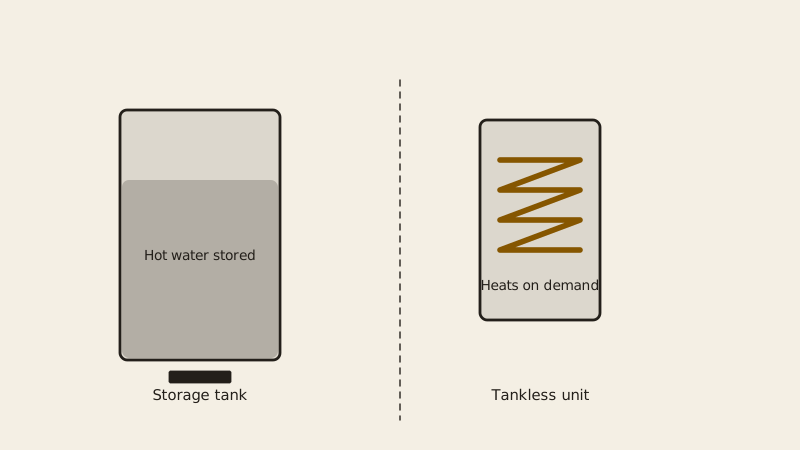
A tank holds 40 to 50 gallons hot all day and leaks heat through its walls while idle. Tankless ignites when a faucet opens, so standby loss disappears, but the stream has a ceiling: the Department of Energy puts it near two to five gallons a minute, which is why a large household sometimes ends up with two units.
| Storage tank | Tankless | |
|---|---|---|
| Typical life | 8 to 15 years | 20 years or more |
| Hot water | Ends when the tank is drained | Keeps coming, up to the flow cap |
| Space | Floor area in garage or closet | Hangs on a wall |
| Price at purchase | Lower | Higher |
| Utility demands | Standard gas or electric hookup, relief drain | Larger gas pipe or heavy circuit, plus a vent or exhaust path |
Both cost guides listed in this page's sources give the life figures.
What do the units and the installation cost?
One published estimate set (2023 dollars, before rebates) lists an installed gas tankless at roughly $1,550 to $3,050, depending on whether the unit is condensing. Whole-house electric tankless is about $1,200 to $1,700 before any panel upgrade. A 50-gallon gas tank is about $1,650 to $2,850, and a 50-gallon electric tank about $1,600 to $2,100.
Another guide spreads wider, tanks from $600 up to $3,100, gas tankless $2,500 to $5,600, because retrofit labor is counted. The gap itself is informative: vent route, pipe diameter and panel room weigh heavier on the final bill than the brand does. Deeper numbers: what a tankless install runs and replacement pricing. Take each figure as a ballpark. The actual price shows up only in a written quote from someone who has stood in your garage.
What does a gas tankless heater demand from the house?
A gas tankless burns a big load of fuel in seconds, so the supply pipe is frequently too narrow if it was sized for a tank. Non-condensing models also call for stainless steel vent material, while condensing ones can use PVC, CPVC or polypropylene, per the hvacbase page.
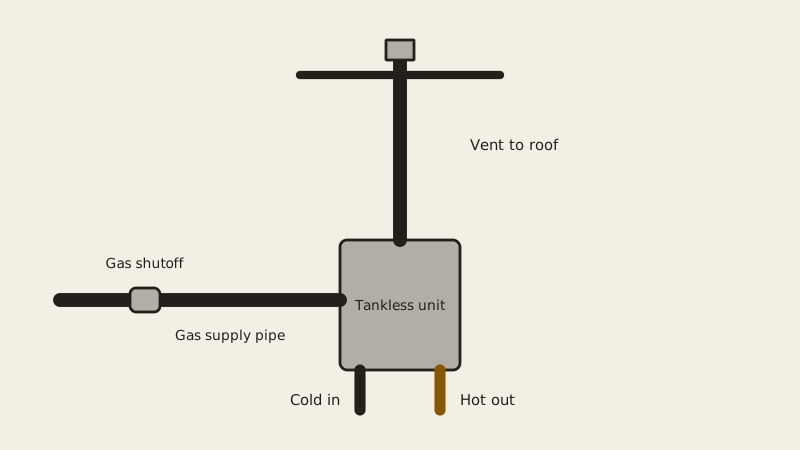
Touching gas pipe is work for a contractor, and a heater swap needing a permit is too. Work totalling $1,000 or above with parts included needs a contractor under state law; the heater permit is issued by Rancho Cucamonga Building and Safety through its online process. Gas odor? Get outside. Leave first, then phone SoCalGas from a safe spot; 911 if that fails.
Up in propane country, such as the Mount Baldy area, confirm any unit is built for propane before you compare prices.
How big is the monthly saving from tankless?
On gas, modest but real. One estimate puts condensing gas tankless near $345 a year for four people against about $513 for a gas tank. It assumes $1.48 a therm, which is not a SoCalGas tariff, so read your own bill.
On electric the two nearly tie: roughly $1,193 against $1,257. A separate guide says tankless needs 10 to 15 years to pay back its premium from energy savings alone. Plan to leave in five years? A tank wins.
Do the arithmetic yourself: extra installed cost divided by yearly saving gives the payback in years. Compare that against how long the house is yours.
Does hard water here change the answer?
Scale punishes both types, tankless more. In the CVWD 2025 report, total hardness is 109 to 142 ppm with a 125.5 average, close to 7.3 grains per gallon. Upland's 2024 report shows about 163 ppm on average for the city system, well above the CVWD figure.
Chalky deposits coat a heat exchanger and pile up on a tank floor. Tankless wants a periodic descale. A tank wants flushing and a look at its anode rod. Weighing a softener as well? See water softeners and treatment.
Mini tanks, propane models and tankless repair: what should I know?
Mini tanks are compact point-of-use heaters about the size of a footstool, under a lone sink, or serving a bathroom that sits far from the main heater. They will not run a whole house, but they end the wait at one tap. Propane tankless works like the gas kind and is built for propane supply.
When a tankless flashes an error or delivers lukewarm water, scale, a dirty inlet screen or a bad sensor is the usual cause. Tankless repair lists the first checks.
Articles stamped 2016 or earlier quote prices and efficiency standards that moved on. Check the date. The front page lists the other work we arrange.
No hot water, or only a weak trickle: what is going on?
Nothing hot at all points to a tripped breaker, a dead pilot or igniter, or a burned-out element. Weak hot flow beside a strong cold flow suggests mineral crust inside the heater, a plugged aerator screen, or a half-shut valve on the heater inlet. Check these before assuming the whole unit is finished.
Popping noises or a wet floor mean stop and call; urgent visits are described on the emergency plumber page. Through request a quote you can send the details and ask for both options priced.
Common questions
What is the downtime for a heater swap?
Tank for tank, figure on about half a day once the plumber arrives. Converting to tankless stretches toward a full day because the gas pipe, vent and wall bracket are all new. Permit and inspection land on separate days, so plan on losing hot water for at least that working day.
What belongs in the quote before I sign for a new heater?
Check whether permit filing is handled for you, whether vent parts and gas pipe changes are inside the price, who hauls the old tank away, and how an electric unit's panel gets dealt with. Any contractor's license can be checked on the CSLB website. Finally, ask what the total becomes should the inspector demand an extra fix.
Does a tankless make sense for one or two people?
Usually the payoff is thin. Low-use homes get the highest efficiency gain in percentage terms, but the yearly dollars are small because the bill is small. The extra installed cost then takes a long stretch to earn back, so a tank frequently ends up the better buy for a small household.
Must the homeowner stay for the install?
For the arrival and the finish, yes. The plumber needs the garage or closet opened, a decision from you if something unexpected turns up, and your sign-off at the end. Expect the supply off for a stretch, sometimes gas as well, so bathe and wash clothes before or after.
Updated