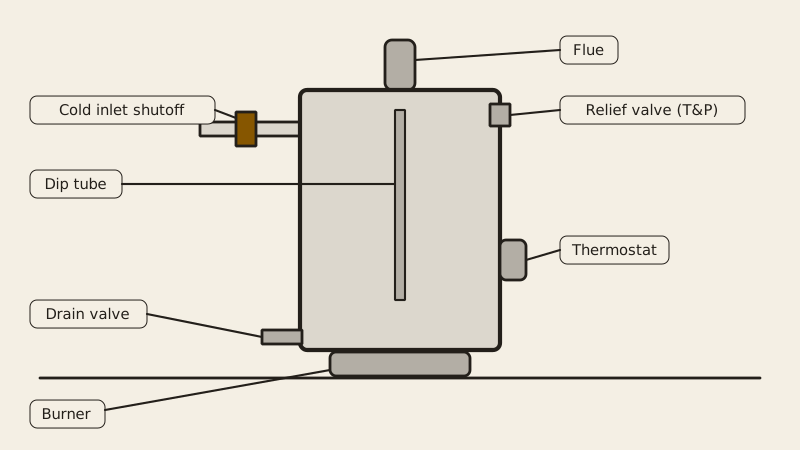
A cold shower at 6am feels like a crisis, yet it rarely is one. What turns a dead heater into an emergency is what comes with it: raw gas in the air, a puddle spreading across the garage floor, or a discharge pipe blowing near-boiling water. This page sorts the cases, lists what your own hands can safely do early on, and sketches the bill. We line up the visit; the quote request form is where it starts. For the unhurried version of this topic, see water heater repair.
When does a cold heater become urgent?
Not on its own. A heater that simply stopped heating is an inconvenience, and in most households a scheduled appointment is fine. Treat it as urgent only when it comes with a hazard, or when somebody in the house, a newborn or a relative home from surgery for example, depends on warm water every day.
Sort it with two questions. Is anything unsafe (a smell, a leak, scorching, strange noise)? Is anyone in the house unable to cope for a day or two? Two no answers mean you can book normally. A yes to either means say so in your request.
Before you call, try one free thing. Electric tank: cycle its breaker once. Gas tank: peek at the burner window and listen for the igniter clicking. A pilot that went out once is no big deal; a pilot that repeatedly dies hints at a draft, a worn thermocouple or a vent problem.
Which failures should not wait until tomorrow?
Four things jump the queue. A gas odor. Water pooling around the tank. Scalding water pushing out of the relief valve pipe. A heater that bangs or shrieks while the water runs far hotter than the dial says. Each can end in fire, flooding or burns, so shut down what you safely can and request the earliest slot.
Gas odor. Leave first. Outdoors by now? SoCalGas takes the call at 1-800-427-2200. Dizzy, or no answer? Dial 911. Light switches, garage door openers and indoor phones can all spark. Relighting anything yourself is off the table.
Pooling water. The shell is the usual culprit. Steel tanks corrode from the inside, and once a seam weeps there is no patching it. A drip at a pipe fitting or valve is a different, smaller story, which is why a photo helps.
Relief valve gushing. A slow drip now and then can come from thermal expansion. A steady hot stream means the unit is running away from its thermostat.
Hammering, whining or steam. Light popping often means sediment. Violent noise plus very hot taps does not.
Keep clear of the tank wall and the discharge pipe. Water much above 120 degrees Fahrenheit burns skin fast, and children get hurt quicker than adults.
What should you do with your own hands first?
Kill the heat, stop the inflow, mop, and then stop. Anything beyond that, such as draining the tank, loosening gas connections or opening the panels of a live electric unit, belongs to the plumber, because a small fault gets expensive when someone improvises.
Here is a sensible order:
- Gas model: set the control dial to its off mark. Electric model: throw the heater's breaker.
- The cold feed comes in over the lid of the tank; its handle turns clockwise to close. A seized handle is a sign to use the main house valve instead.
- Open one hot faucet briefly to relieve pressure, then close it.
- Photograph the rating label, the leak and any blinking code.
- Note the time the trouble began and what happened just before it, like a power flicker.
Wet carpet or drywall deserves fast drying, since mold can start inside about two days. Keep the photos for insurance.
What might an urgent water heater repair cost?
A published repair guide gives a typical spread of $150 up to $750, averaging around $450, with hourly labor of $50 to $150. Urgent calls carry a premium it puts around $100 to $200, plus a trip charge near $50 that some plumbers waive when you approve the repair.
The same guide splits the spread by what broke:
| What failed | Ballpark |
|---|---|
| Thermostat, repair or swap | $75 to $250 |
| Relief valve, new | $100 to $250 |
| Heating element, new | $200 to $750 |
| Overall repair range | $150 to $750 |
A worn thermocouple on a gas unit lands low in that table. A shell leak is missing from it entirely, since that means a new tank. All of this is a national snapshot from a single site, so the figure that matters sits on the quote written for your own house by a local plumber.
Is it worth fixing, or time for a new heater?
Repair when a component failed and the tank holds: igniter, thermostat, element, valve. Replace when moisture comes through the tank wall, rust blooms along the bottom, or the unit is elderly and a fix would swallow most of a replacement's price. Once the steel shell leaks, it stays leaky.
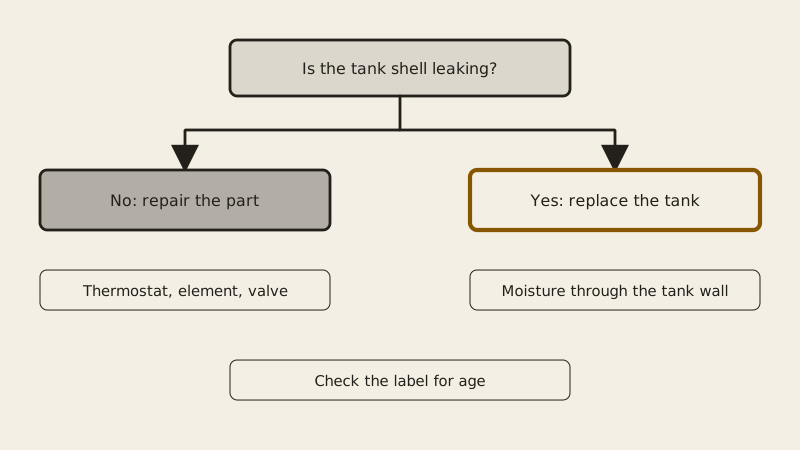
Three details tip the decision. The age: the serial number usually hides a manufacture date. The leak source: fitting versus shell. And whatever paperwork you have, since a warranty may cover a failed part.
If you are leaning toward replacement, a tankless model deserves a look. There is no forty-gallon reservoir to empty onto the floor, but gas sizing and venting need care. The tank vs tankless article weighs the trade.
Swapping a heater in the city usually involves a permit. Rancho Cucamonga's Building and Safety division issues them online only, and the plumber normally files that for you. Ask whether earthquake strapping is priced into any replacement quote.
Does local water make heaters fail sooner?
Somewhat. Cucamonga Valley Water District's 2025 report lists total hardness between 109 and 142 ppm, about 125 on average, while its own FAQ calls the supply moderately hard to hard. The USGS puts 121 to 180 mg/L in the hard class. Warming water pushes calcium out of solution, so it crusts onto elements and the tank bottom.
You hear it first. Crackles when the burner fires, slow recovery, an electric element that burns out early. Flushing once a year and inspecting the anode rod buys time.
Which supplier reports your hardness depends on your street. The city is mostly the district's territory, but properties near the Etiwanda edge may belong to a neighboring company, and Upland has its own utility with a different report. Your water bill names who serves you.
Age adds to it. Heaters installed during the 1980s through 2000s building waves are now on second or third units, so a sudden failure in a house of that era is more often old age than bad luck.
How do you ask for an urgent visit?
Open the request form and put the emergency detail in the first sentence. Staff on the phones work a weekday schedule, 9am to 5pm. Anything sent outside those hours is read when we open, so there is no overnight dispatch to promise.
Include these items in the request:
- Heater type: gas tank, electric tank, tankless.
- Brand and approximate age from the label.
- A photo of the leak, code or valve.
- What you already shut off.
- Address, plus when somebody can open the door.
Nothing starts until a written quote names the failed part. When venting, gas piping or a permit enters the picture, that goes on the quote too. For slower problems, the no hot water causes article covers slower problems, the home page has the full service list.
Common questions
Is there night or weekend dispatch for a failed water heater?
No. We work weekdays only, from 9am to 5pm, and anything sent after closing waits for the next opening. If gas is the problem, skip us entirely: step outside, call the gas utility using the number given earlier on this page, or 911 when that fails.
Which questions come first when a repair is urgent?
What broke? What is the total with any after-hours fee? Does the job need a permit? If a second fault appears once the panel is off, who approves the extra work? Get that figure on paper before work starts; hurry is no excuse to skip it.
Can the house be empty while the plumber works?
Not for the whole visit. At the start, somebody points out the heater and its shutoffs; at the end, somebody checks the result. The stretch in between only needs clear access. A heater in a locked garage or behind stacked boxes should be mentioned in the request.
Why does emergency work cost extra?
The published guide above adds about $100 to $200 to an urgent repair. Other sites quote percentage markups instead, and those run higher. Ask for the urgent fee as a separate line so quotes line up side by side. A next-business-day slot often drops it.
Is a small heater leak really worth worrying about?
Yes, slow drips pile up. In EPA numbers, the typical leaky home wastes more than 9,300 gallons annually. A weeping fitting is cheap to fix now and costly after it floods a closet, so have the plumber check whether it is a fitting or the tank itself.
Sources used
- Fixr, water heater repair cost guide (updated August 2025)
- Cucamonga Valley Water District, 2025 Water Quality Report
- Cucamonga Valley Water District, frequently asked questions
- USGS, hardness of water
- SoCalGas, natural gas leak safety
- City of Rancho Cucamonga, Building and Safety
- EPA WaterSense, Fix a Leak Week
Updated