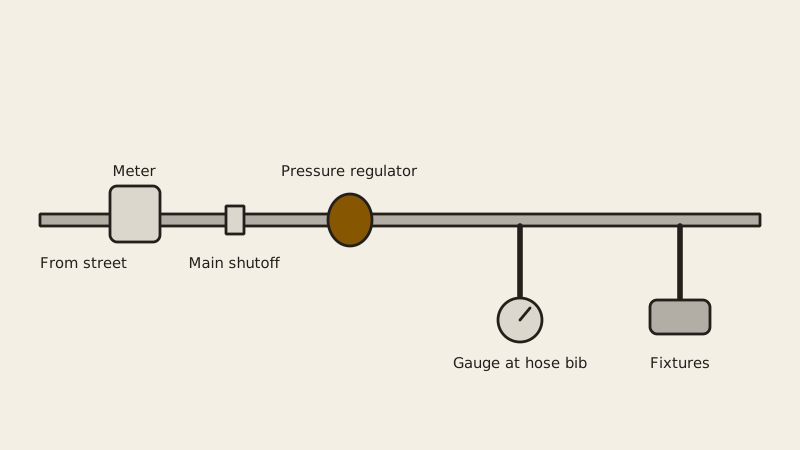
A dribbling shower is annoying, but the pattern of weakness says nearly everything. Just one faucet suggests a clogged aerator. Only the hot side suggests the water heater or a valve beside it. When every outlet is equally weak, the usual suspects are the incoming pipe, a worn pressure-reducing valve, or the street supply. We book a local plumber to sort out which, and the quote is on paper before work begins. Our other services are on the Cucamonga Peak Plumbing home page.
Does the weakness start inside my house or outside it?
Two quick checks settle it. Ask next door whether their flow dropped too, and screw a pressure gauge to the outdoor hose connection with all indoor taps off. One published guide calls 40 to 60 psi ideal, with 80 the code ceiling. A low number plus a neighbor with the same complaint points beyond your property line.
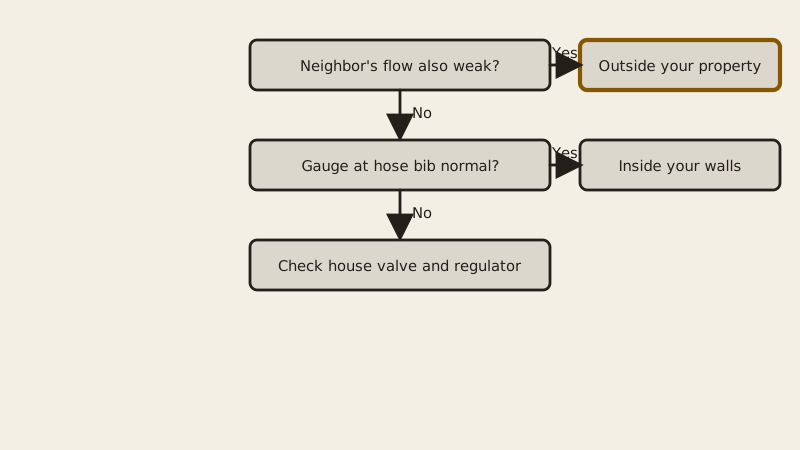
Cucamonga Valley Water District serves most of Rancho Cucamonga, and a main repair or a hydrant flush nearby can briefly sag pressure on a block. Check your bill for who supplies you, because a few edge areas belong to other systems. A reading that is normal at the bib but weak indoors means the trouble sits inside your walls.
At what point does weak pressure justify a plumber visit?
Book one if every outlet is weak, if the drop was abrupt, if pipes knock, or if cleaning aerators and shower heads made no difference. Those patterns suggest a failed regulator, a half-closed or corroded valve, a leak, or pipe that has narrowed with age. One slow shower head is a cleaning chore, not a service call.
Sudden drops are their own category, and the guide on a sudden loss of pressure at home goes through them in order. If the shower is the only weak spot, low pressure in the shower is the shorter read.
What can I try myself before booking?
Start at the fixture. Unscrew the aerator or shower head and leave it in a bowl of vinegar for an hour. Rancho Cucamonga tap water is moderately hard: the district's 2025 report lists hardness averaging near 125 ppm, which works out to about 7 grains per gallon, plenty to crust over the tiny holes in a screen.
Then inspect the two shutoffs in line, the meter valve and the house valve. Gate valves left half closed after some earlier repair turn up often. Check that the hot side matches the cold side. If the water heater's shutoff is partly closed, only hot water suffers. Stop there. Cutting into pressurized pipe or adjusting a regulator without a gauge is better left to someone with tools.
What does a pressure regulator do, and does a house need one?
Near the house shutoff, find the squat brass bell on the supply pipe. It is the regulator, built to trim incoming pressure so fixtures never feel the full force. Under CPC 608.2, pressure at a fixture may not exceed 80 psi, so any home with stronger supply needs one. Higher ground generally means higher supply pressure, so foothill streets are worth a gauge check.
A failing regulator can go two ways. It can choke flow so everything feels weak, or it can stick open so pressure swings and pipes bang. Plenty of models can be adjusted, as shown in the regulator valve adjustment guide, but without a gauge you are guessing.
Will a regulator stop water hammer?
Often it helps, but not always. Hammer comes from fast valve closure slamming a column of moving water. Lower and steadier pressure softens the blow, and a tired regulator often lies behind banging that starts for no other reason. Where it persists, the fix is usually an arrestor at the offending valve or an air chamber that has gone waterlogged.
What to listen for, and how to find the fixture that starts the knocking, is in the water hammer sound. If the gauge sits far above 80 psi at 3 a.m. with every tap idle, blame the regulator first.
How old can a regulator get before it needs replacing, and what is the bill?
One published guide gives a typical regulator lifespan of 10 to 15 years, shortened by sediment, high mineral content, sustained pressure above 80 psi and repeated hammer. The same guide puts a plumber-installed replacement at about $350 to $650, with the part itself near $50 to $150 and labor about $200 to $450.
| Item | Published range |
|---|---|
| Regulator unit | $50 to $150 |
| Plumber labor, 1 to 3 hours | $200 to $450 |
| Total replacement | $270 to $650 |
| Standard residential labor per hour | $75 to $150 |
A tight crawl space, copper needing a torch, or a night visit pushes the total up. Every figure above is a national guide number, not a bid from this area, and your own price comes from the quote a local plumber writes after looking. For a closer look, see regulator installation cost.
Can aging pipes alone explain thin flow?
Yes. Galvanized steel supply lines, which turn up in some pre-1960s houses around old Cucamonga and downtown Upland, corrode inward and can lose most of their bore. Copper can also scale. If the pressure at the street and the regulator both test fine but the flow at the faucets stays thin, the pipe walls are the suspect.
A plumber can compare gauge readings at several points and cut a short sample out to look at the inside. If the pipe is choked, the real fix is replacement, either section by section or as a whole-house repipe. Read galvanized pipe replacement before committing to a quote.
Does low pressure matter for sprinklers and drip lines?
It does. Pop-up spray heads want a minimum pressure to throw their pattern, and a zone that fogs instead of sprays or never lifts the heads is a low-pressure sign. Drip systems, however, need a pressure reducer anyway, so they tolerate lower supply. Someone should test the supply at the irrigation tee, and the nozzles themselves need their own look.
Foothill lots with long runs and elevation changes behave differently from flat tract lots, since head differences between the valve and the highest sprinkler change the pressure each head sees. If only the irrigation drops, the problem may be the backflow device on that line rather than the house plumbing.
Common questions
Is low water pressure dangerous?
The weak flow itself rarely harms anyone, but it hints at something wrong, such as a leak, a stuck valve or corroded pipe. It can also make a tankless heater cut out or a dishwasher fill badly. Very low pressure also weakens fire sprinklers where a home has them. Trace the cause rather than living with it.
Does every house need a pressure regulator?
No, but a house whose incoming pressure tops the 80 psi fixture limit does, and plenty of tract homes already have a regulator by the main shutoff. A spigot gauge gives the answer. Under 80 psi around the clock, you may not need one.
Can I swap a regulator myself?
Handy owners do, but it involves shutting off the main, cutting or unthreading pipe, and often soldering on copper. A wrong setting can overpressure fixtures, and some jurisdictions expect a permit. If your lines are old or the valve is hard to reach, hire it out and ask for the pressure setting in writing.
What is the time frame for a water heater swap?
A direct tank-for-tank exchange takes part of a day. Vent changes, gas piping, an expansion tank or a permit inspection add time, and a switch to tankless takes longer still. Seeing the site first lets the plumber state a real window.
Can drinking water raise low blood pressure?
Blood pressure is a medical subject and has no link to the pressure in your home's pipes. A doctor is the person to ask about it, not a plumber. If you arrived for the plumbing, the sections above are the useful ones.
What can I do if I cannot afford a plumber right now?
Do the safe jobs first: clean aerators, open valves fully, stop drips. Then ask for more than one written quote and find out which items are urgent and which can wait. Some water utilities run assistance programs, so ask your supplier what exists.
More in this guide
- Water pressure and valves
Check static pressure with a gauge, loosen the locknut, turn the screw in quarter turns, retest.
- Sudden low water pressure
Water pressure suddenly dropped at home in Rancho Cucamonga or Upland?
- Costs
What a water pressure regulator costs to install or replace in Rancho Cucamonga: published ranges by pipe size, what raises the bill and…
Sources used
- Plumbing Tips Today, cost to replace a PRV
- Plumber price guide citing Housecall Pro and Jobber, Zarla
- Modernize, plumber cost per hour
- Cucamonga Valley Water District 2025 Water Quality Report
- Cucamonga Valley Water District FAQ
- California Plumbing Code section 608.2 (80 psi limit at fixtures)
Updated