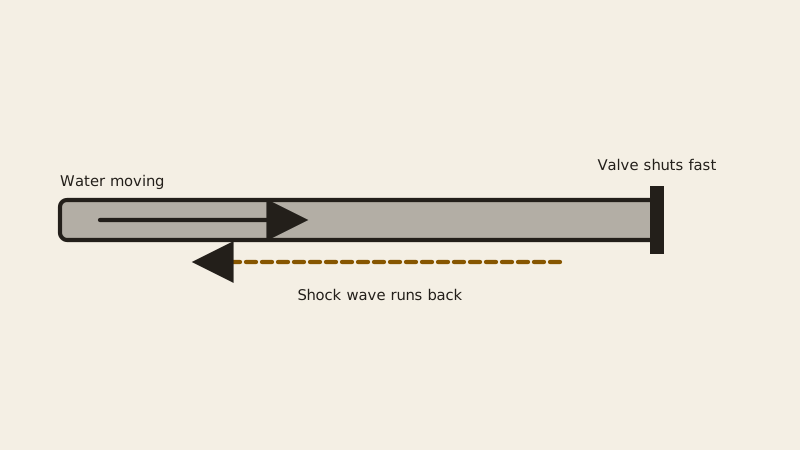
A pipe full of moving water carries real momentum. Slam a valve and the whole column halts at once, sending a shock wave back down the line that you hear as a bang. Plumbers call that water hammer, and it turns up in Rancho Cucamonga houses of every age. Typical triggers are strong incoming pressure, pipes free to slap their framing, or cushioning chambers that have gone flat. Everything else we arrange for local homes sits behind the Cucamonga Peak Plumbing home page. What follows covers identifying the noise, the homeowner steps worth trying, and the point where a contractor takes over.
Can I tell hammer apart from other pipe noises?
A thump the instant a tap, dishwasher or washer valve closes is hammer. Different sounds, different causes: ticking or creaking while hot water runs suggests pipes growing as they warm, a shrill whistle often means a worn or half-open valve, and a low rumble from the heater can mean sediment. Timing gives it away.
Try this. Run a single fixture and shut it fast, then run it again and shut it slowly. A bang only on the fast close is hammer. If the noise comes with hot water but not with cold, look at expansion or sediment instead. Mark which fixture sets it off, because that tells a plumber where to look.
What can I try myself before calling someone?
Three jobs suit a homeowner: refill the air chambers, secure exposed pipe within reach, and take a pressure reading. None needs a torch, and together they cure plenty of houses. Banging that survives all three has a cause deeper in the system.
To refill the chambers with air, close the main, empty the system by opening the top-floor and lowest taps, close them, then reopen the main gradually. Air returns to the vertical stubs behind the fixtures. For loose runs beneath the floor or along a garage wall, add padded clamps every few feet near the bend where the knocking lands. Leave gas piping alone entirely.
Could hard water play a role?
Scale builds up inside pipes and in the narrow passages of valves and regulators, so those parts can start misbehaving. The district's 2025 water quality report, from the Cucamonga Valley Water District, shows average hardness near 125 ppm, which makes scale a realistic factor in older fixtures. Scale will not start hammer alone, but a tired regulator or cartridge gets worse with it.
Flushing the water heater and cleaning aerators are cheap upkeep, though neither is a cure. If a valve is sticking or sluggish, replacing the part is usually better than cleaning it for the third time.
Is water hammer harmful, and who should I call?
Occasional light taps are mostly a nuisance, but repeated hard bangs stress joints, can loosen fittings, and over time can shorten the life of valves and appliance hoses. A pipe that has begun to weep at a joint after months of hammering is not a noise problem any longer. It is a leak, and leak repair is the page for that.
Bring in a contractor if the wall shudders with each bang, if the gauge climbs past 80 psi, when you suspect old galvanized lines, or when you find any dampness at a fitting. Older homes in parts of Cucamonga and Upland may still have galvanized steel, discussed in galvanized pipe replacement. Work on a regulator or the main line should be done by someone with a state contractor license.
A rattling gas pipe or a whiff of gas is a different matter. Everyone steps outside first. From there, the number for SoCalGas is 1-800-427-2200. Strapping or altering gas piping is no job for a homeowner.
What does a water hammer arrestor do, and where does it go?
An arrestor is a small capped body with a piston or bladder in it, there to take the shock when flow stops. It goes in at the offending fixture, most often the hot and cold supply to a washing machine. It takes over from the old air chamber, which eventually fails because its air slowly dissolves into the water.
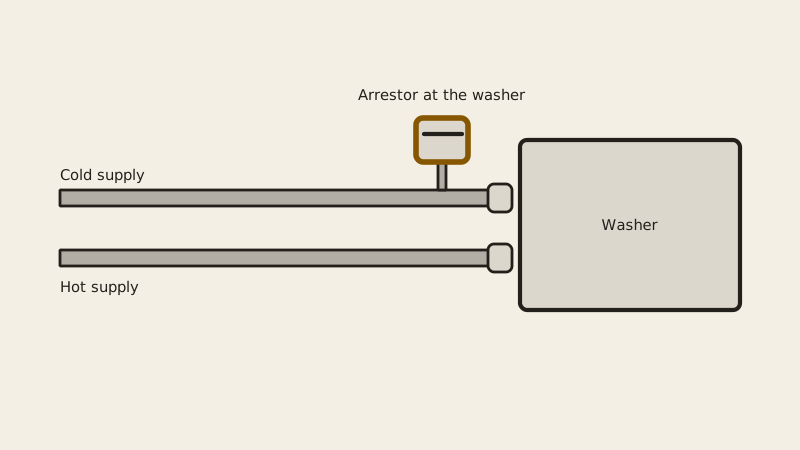
Screw-on arrestors for washer hoses are common and cheap, but they do the job only for that appliance. For banging that comes from a whole run of pipe, a plumber may install arrestors in the wall or on the branch that feeds the loud fixture. Ask which fixture sets it off before you buy anything.
What causes water hammer in a house here?
Four culprits cover nearly every case: fast-acting solenoid valves in washers and dishwashers, supply pressure that is too high, loose pipes that slap the framing, and air chambers that have waterlogged and lost their cushion. One alone can do it. Two together are worse.
Check pressure first. Fixtures are capped at 80 psi under CPC 608.2, and a house on higher ground tends to get stronger supply. Screw a gauge to the hose connection outside in the quiet of the evening and you will know if the regulator is holding. For more on regulators, see fixing low water pressure.
Does a pressure regulator stop the hammer?
Sometimes, when pressure is the trigger. A regulator that failed, or was never set right, lets street pressure straight through, so every closing valve hits harder. Resetting or replacing it can quiet the house in one move. A gauge that stays under 80 psi around the clock points elsewhere.
Plenty of tract homes already have one by the main shutoff, a domed brass fitting. Adjustment is explained in setting a regulator valve, and about the bill for a new one in regulator installation pricing. Either way, buy a gauge.
Common questions
Is a quick fix realistic for the banging?
Refilling air chambers and adding pipe straps may take under an hour. An arrestor or a regulator swap generally means a visit of a few hours, and tracing noise inside walls can take longer. A plumber can name a window once the noisy fixture is found and pressure is measured.
What are sensible questions for the plumber about hammer?
Ask what the diagnosis is, whether pressure was measured, which fixtures get arrestors, and what the price includes. Ask also whether the old air chambers will be refilled and whether a regulator is in the plan. Ask for the figure in print, and confirm with the state's license lookup that the contractor is in good standing.
Should I be around for the appointment?
Yes, so you can show which fixture bangs and approve any opening in a wall. Run the noisy fixture beforehand and be ready to say exactly when it happens. The water will be off briefly, so schedule laundry and showers around it.
Sources used
- California Plumbing Code section 608.2 (80 psi limit at fixtures)
- Cucamonga Valley Water District 2025 Water Quality Report
- SoCalGas, natural gas leak safety
Updated