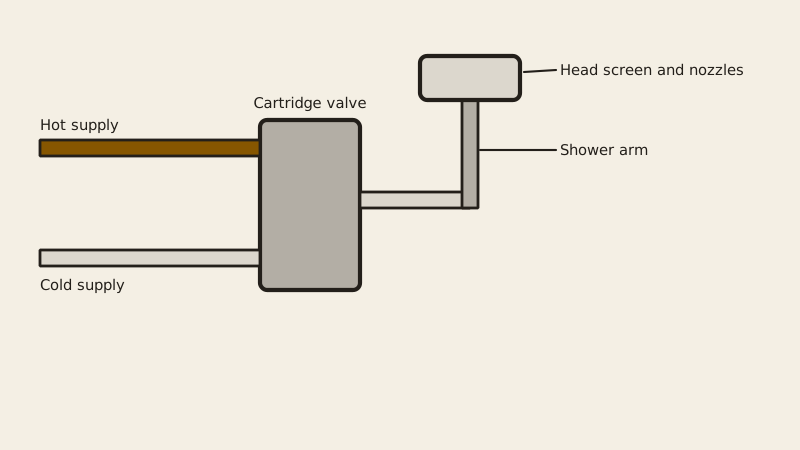
Ask yourself one thing before touching a wrench: does the weakness belong to the shower alone, or to the entire house? The answer removes half the suspects. You will find this guide in the section on faucet, sink, shower and disposal repair. It travels backward from showerhead to valve to heater to house supply. If the trouble lives in a wall or out at the street, request a plumber and we'll arrange one.
Is the weakness limited to the shower?
Open one bathroom faucet and one kitchen faucet at the same moment. If those gush, the weak shower has a local fault: head, hose, cartridge or the short pipe feeding that valve. If they dribble too, look upstream: a half-shut main, a tired regulator, rusted pipe or the supply.
A rough decision path:
- One shower only. Look at the head, its restrictor, the arm, the cartridge or the diverter.
- Hot weak, cold fine. Inspect the heater and its surrounding valves.
- Cold weak, hot fine. A stop opened only partway, or grit in the mixing valve's cold side.
- Every fixture, hot and cold. The house supply. Jump to the gauge test further down.
- It happened overnight. Something changed, perhaps a valve nudged shut. Sudden low pressure deals with that.
Is a clogged showerhead the likely cause?
Usually. Minerals harden across the tiny nozzles and the screen inside the head, so the spray thins even though the remaining taps run normally. Remove the head, peer into the inlet for grit and white crust, then clean or replace it. Of all the causes here, this one is the cheapest to test.
Local water explains why scale is so common. Cucamonga Valley Water District's 2025 analyses found hardness between 109 and 142 ppm, and the City of Upland's 2024 report shows 163 ppm for its own system. Heat and tiny openings make a showerhead the first place that crust shows.
A cleaning routine that often works:
- Spin the head off the arm anticlockwise, a cloth around the joint to spare the finish.
- Clear grit from the fine mesh screen in the inlet.
- Let the head sit in a bowl of vinegar for an hour, maybe two. People commonly do this at home; for brass, plated or coated heads, the manufacturer's care sheet comes first.
- Thumb the rubber nozzles to crack loose softened scale, rinse, and refit with new thread tape.
A head that stays weak after cleaning is due for replacement. EPA's showerhead page also suggests checking the washer or o-ring inside when you swap one.
Could a low-flow showerhead be the culprit?
Possibly, though not automatically. EPA gives 2.5 gpm as the figure for a standard showerhead, and a WaterSense label limits that to 2.0. The labeled ones are also tested for spray force, and for keeping a minimum flow when household pressure varies, so a good one should feel fine.
A swap that made things worse suggests a poor spray design, not a pipe fault. Try another model before assuming the worst. Easy proof: remove the head, aim the bare arm over a bucket and watch the stream. A hearty gush from the arm blames the head.
Drilling out the restrictor inside a head is a popular hack. It may break the label and raise hot water use, so replacing the head is the cleaner route.
What if the head is fine and flow is still poor?
Move on to the valve. A cartridge valve can have its inlet ports half blocked by debris or scale, which starves one or both temperatures. A diverter that fails to switch cleanly between tub and shower can also leave the head with only a fraction of the flow.
Valve warning signs:
- The weakness shifts as you move the handle, or the temperature wanders.
- The tub spout drips whenever the shower is running.
- The valve sputters or rattles on opening.
- One temperature is noticeably weaker than the other.
Pulling a cartridge follows the moves used on any faucet; fixing a leaky faucet shows them. Wall valves need the water cut first, from the house main when no stop is nearby. Staining, softness or a damp smell around the shower means a different problem; see a shower leak instead of pushing on.
Is the water heater holding back the hot side?
Weak hot with healthy cold directs suspicion at the heater and nearby pipes. Sediment, a half-open valve on the heater outlet or a worn mixing valve can each choke hot flow. A shower that never gets warm is a neighboring issue, and no hot water answers it.
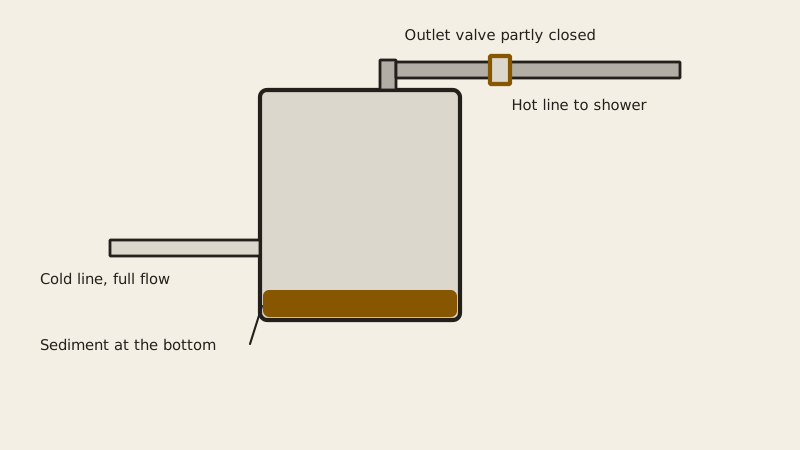
Sediment accumulates in tank heaters year by year, and the hardness numbers above make that likelier locally. Flushing the tank and testing the valves is plumber territory. Do not lift the relief valve lever to test it unless you know the procedure: scalding water can pour out, and an old valve may not reseat.
Gas heaters bring one more rule. If you notice gas odor near the unit, get everyone outdoors, then phone SoCalGas's emergency number, 1-800-427-2200. If danger is immediate, 911 comes first.
How do I measure the house pressure?
A small gauge on an outdoor faucet costs little and shows the house's static pressure. A low number suggests a half-shut main, a failing regulator, a blocked strainer or rusted pipe. A very high one matters as well, since the plumbing code allows no more than 80 psi at a fixture (section 608.2).
Cucamonga Valley Water District's FAQ states that a customer who has a regulator is responsible for maintaining it. An aging regulator can stick low just as easily as high. Adjusting a regulator explains the basics, and regulator installation prices help when replacement is next.
Pipe age counts as well. Older houses in Cucamonga and Upland can still carry galvanized steel, which rusts inward and narrows with the decades; ZIP code 91786 in Upland has 1,331 homes built before 1940. Newer Rancho Cucamonga neighborhoods tend toward copper or PEX. If an old galvanized house has weak flow at many fixtures, read about galvanized pipe replacement. No verified pressure figures exist for the foothill streets, so measure instead of assuming.
Which findings call for a plumber?
Call one if the shower is still weak after a clean head and a new cartridge, if all fixtures are weak, if the gauge reads outside the healthy range, if the wall behind the shower is damp, or if no shutoff in the house works. Those jobs need tools, access and sometimes a permit.
Throughout Rancho Cucamonga, Upland and the foothill neighborhoods, a request through us brings a local plumber out. Once a job passes $1,000 in total, or needs a permit, the person doing it must hold a California contractor license; a whole-house repipe is above that, a showerhead far below. The home page points to other services.
Common questions
What makes a shower weaken overnight?
Something changed. Likely suspects: a valve bumped shut during other work, a clogged cartridge, a failed pipe, or an outage on the supply side. Compare other fixtures, ask a neighbor, and glance at the water bill for signs of a leak. If nothing explains it quickly, call.
Do pressure-boosting showerheads help?
Sometimes. Many simply narrow the spray so it feels stronger without adding flow, and none can cure a blocked valve or poor supply. If the same head performs well in another bathroom, the head is fine and the pipes are the issue. Test the bare arm before you buy.
Can hard water alone weaken a shower over time?
Yes. Scale slowly narrows nozzles, screens and cartridge ports, and flow fades so gradually you stop noticing. Cleaning the head on a schedule slows it. Softening the water for the whole house is another route, a much larger step than a vinegar soak.
Which details help most when I book?
Report whether one shower or every fixture is weak, which temperature is affected, when it began and what you already tried. Add the home's age and any gauge reading. That narrows the diagnosis and keeps the visit short, which is the point.
Updated