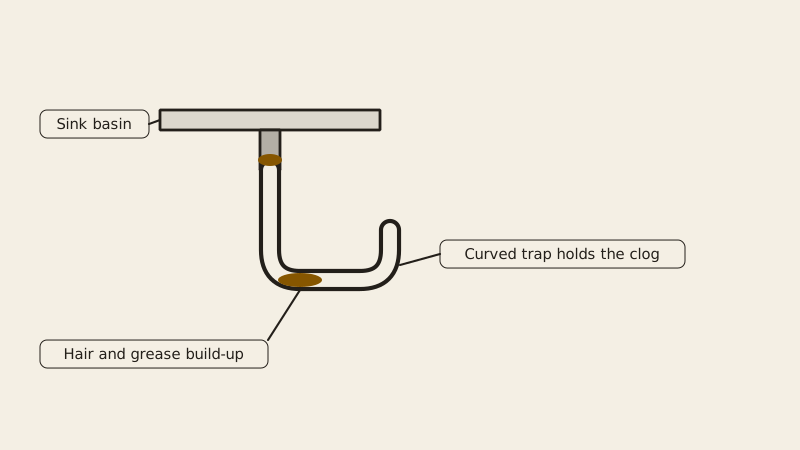
Watch the basin next time it empties. If the water spirals away lazily, lingers at the rim or burbles on its way out, the pipe has lost width. The culprit is nearly always close to the drain opening, and the cheap fixes work more often than people expect. Below: what each pattern points to, a sequence that goes from harmless to heavy, and the moment to stop and call someone. Toilets behave differently, and the clogged toilet plumber page deals with those.
Why does a sink drain slowly in the first place?
Four ingredients cause most cases: a greasy or soapy film, hair, food scraps, and hard mineral crust. They stack up on the pipe wall and shrink the opening. Something lodged further along the branch line is the rarer explanation. Where the slowness appears is the best clue to which one you have.
| Pattern | Most likely story |
|---|---|
| One bathroom basin, worse each week | Hair and soap around the stopper or in the curved trap |
| Kitchen only, greasy smell | Cooking fat on the pipe wall, holding food particles |
| One bowl of a double sink | A blockage past the shared outlet, or a disposal side jam |
| Basin, tub and toilet all sluggish | A branch or main line issue |
| Gurgling from a different drain | Partial clog or a vent problem |
Local water adds a little. The local water district's FAQ puts the supply between moderately hard and hard, and a USGS page explains that warmed hard water drops calcium carbonate deposits, which can pinch pipes slowly. Inside sink drains you meet it mostly on stoppers and traps, since hot water flows there.
What drags down a bathroom basin?
Hair wins. It snags on the stopper's lever and in the trap, then toothpaste, soap and styling product glue it into a gray plug. The result tightens gradually over a few weeks, and the snag sits a short reach below the opening.
Many basins have a pop-up stopper worked by a rod behind the faucet. Lifting the stopper out is frequently the entire cure, and a wad of slime tells you so right away. A narrow barbed plastic strip, sold cheaply at hardware stores, pulls out what you cannot see without any chemicals.
More detail sits in the walkthrough for bathroom sink blockages.
Can a sink be slow without being blocked?
Yes. A slow sink that still empties has a narrowed path, not a plug: water squeezes past whatever is in the way. That is the cheapest moment to act, because partial clogs shift with far less effort than total ones, and they only get worse.
Air is the other reason. Flowing water also pulls air behind it, and that air arrives through a vent pipe ending on the roof. If a leaf or a nest blocks it, water drains in sluggish gulps and neighboring fixtures may gurgle too. Nobody should be climbing onto a roof to check, so that diagnosis goes to a plumber.
Listen to the pattern. A bowl that empties briskly and then sputters at the end often has a sludge-filled trap. An even, silent crawl suggests the pipe wall is coated along its length.
When is professional drain cleaning or hydro jetting worth it?
Book drain cleaning once the plunger and trap have failed, if more than a single fixture is slow, or whenever the crawl comes back within a few weeks. Cable machines break through a plug; hydro jetting uses a hard stream of water to scour grease and scale from the pipe walls.
A cable is the usual first step. Jetting makes sense for greasy build-up or repeat clogs, but not every pipe tolerates it. A camera run first reveals a cracked, sagging or root-choked line, none of which pressure alone will cure.
House age plays a part. Older Cucamonga and Upland neighborhoods may have tired drain lines, while the planned communities from the 1980s through the 2000s mostly have plastic. A damaged line needs repair, not cleaning. Arranging a visit is explained under plumber service, while the rest of our work sits behind the home page link.
Whoever comes, get the method and the fallback plan named in the quote.
When does a slow sink point to something larger?
If several fixtures are slow, a tub fills with water when the basin empties, or a sewage smell all suggest a problem beyond the sink: the branch, the house line, or occasionally the public main. At that stage, drop the plunger and call a plumber.
Where Cucamonga Valley Water District provides sewer service, the homeowner covers the line from the property boundary to the house, including the cleanout and the back-water valve, per the district's FAQ. The district maintains the collection system past that boundary and says it responds to sewer calls. Upland has a city-run sewer, so an Upland resident asks the city about the public side.
A camera inspection shows which side of the boundary holds the problem. If wastewater is coming up inside the house, read about urgent plumber calls at once, instead of waiting.
Which remedy should you try first, and which works best?
Go from gentle to heavy: lift and wash the stopper, send very hot tap water down, plunge with the overflow stopped, then dismantle the trap. Skip chemical openers: they can attack seals and splash whoever opens the pipe next. If water barely moves at all, call a plumber.
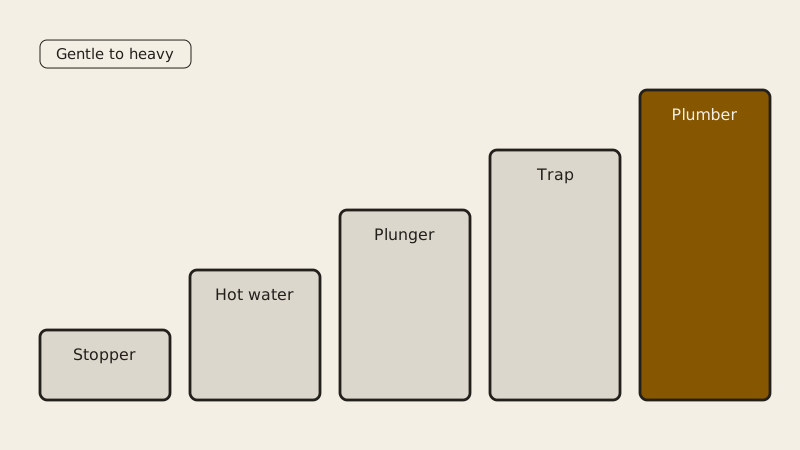
In order:
- Stopper and strainer. Pull, rinse, repeat until the metal shows.
- Hot flow. Very hot tap water, not a boiling kettle, which can warp plastic parts.
- Plunger. A flat-rimmed sink plunger, standing water over its cup, a damp rag plugging the overflow, then a dozen firm pumps.
- The trap. Park a bucket beneath the curve, spin off the two large coupling nuts, tip out the sludge, rinse the parts and put them back.
- Test. Run the tap while watching every joint, and snug a nut if a bead of water forms.
On twin kitchen bowls, stopper the neighboring outlet before you plunge. Otherwise pressure escapes through the shared line and the plunger does nothing.
Baking soda with vinegar makes a satisfying fizz. A thin film might loosen, but a true clog will not budge, so count it as upkeep, not rescue.
What makes kitchens clog faster than bathrooms?
Kitchens send down fat, starch and grounds, and these behave like glue once they cool inside the pipe. Rice and peel stick to the fat, and the opening shrinks to a fraction of its size. A disposal grinds waste finer, which then clings more readily. So kitchens block before bathrooms do.
Double sinks have a quirk: both bowls empty through one tailpiece and trap. When just one bowl is slow, inspect the junction between them and the disposal side. A unit that grinds poorly leaves packed waste just behind it, which is covered in the disposal repair page.
Prevention is dull but effective. Blot oily pans with a paper napkin first, tip cooled fat into a jar, and follow a rinse with twenty seconds of hot flow. For the hands-on routine, use the kitchen sink unclogging steps.
Common questions
Which chemical-free steps unblock a slow kitchen sink?
Wash the strainer, run hot tap water, plunge while the other bowl is plugged, then take the trap apart above a bucket. Most kitchens give way to that routine. If the trap comes out clean and the water still crawls, the blockage is deeper and a cable or jetting machine takes over.
Is plunging a slow sink worthwhile?
Often, yes. A flat-bottomed sink plunger, with the overflow covered, drives force into a partial clog. Go gently on old or loose joints. A bell-shaped toilet plunger grips badly on a flat basin, so reaching for it here wastes effort.
Why is the sink still crawling after I cleaned the trap?
You probably removed only the nearest layer. A deeper clog, a coated pipe or a half-blocked vent can leave the flow slow. Plunge once more, and if nothing changes, ask a plumber for a cable pass or a camera check.
Can a stopper slow the drain by itself?
Yes. A pop-up with hair wrapped on the pivot rod, or one that opens barely a sliver, throttles an otherwise clear pipe. Lift it out, wash it, and check the linkage raises it at least a quarter inch. Quite a few slow bathroom sinks are cured this way in minutes.
Do mineral deposits cause slow drains?
They contribute. Per the district's FAQ, local water is moderately hard to hard, and USGS material links scale with tighter pipes. In sink drains, soap and hair do more harm, but scale builds up on stoppers and traps. A water softener cuts the scale side of the problem.
Updated